
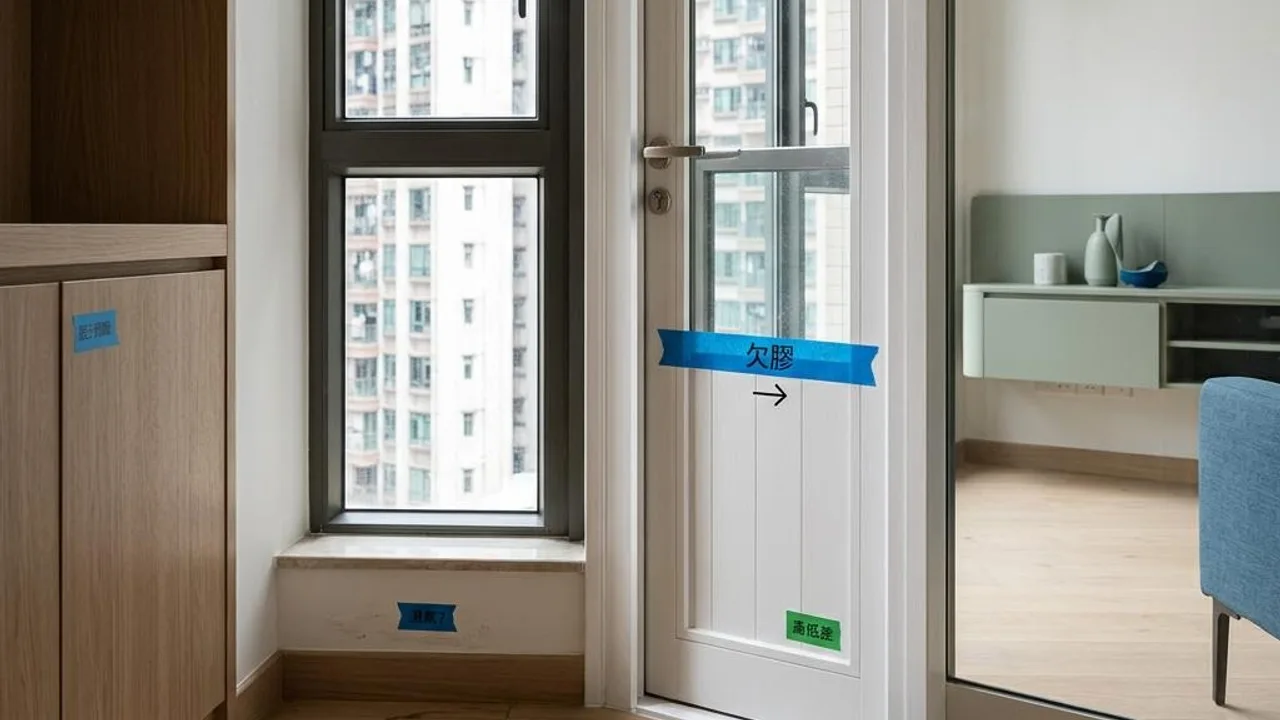
New-home inspection goes beyond walls and tiles
Beyond finishes, check operable doors, windows, locks, cabinets, water and drainage fittings and equipment against the actual delivery and agreed scope. Window edges, visible under-sink connections and protected areas are easy to miss in records. List inaccessible positions separately; a checklist entry is not proof that the item was inspected.
The core significance of property inspection: Status recording and rights protection
During the handover of first-hand properties, even if they look clean visually, problems such as stiff switches, drainage details, or joint defects may be hidden. The core task of property inspection lies in meticulously recording the handover status, providing clear data and location references for requesting defect rectification from the developer later, and protecting the owner's rights.
This process covers accessible items within the agreed scope of the contract, focusing on recording surface defects rather than conducting structural appraisals. Correct recording habits can reduce the cost of subsequent communication with the developer and ensure that the delivered property meets expectations.
list
- Record handover status as evidence for subsequent follow-up
- Focus on issues within the visible and accessible range
- Does not include structural safety or statutory compliance inspections
- The property inspection report does not serve as a guarantee for building structure, electricity, gas safety, regulatory compliance, concealed water pipes, waterproofing layer thickness, remaining useful life, or repair results. Thermal imaging only shows surface temperature distribution and cannot directly prove the cause of water leakage or the condition of concealed structures. Do not treat inspection tools as a guarantee that can reveal all hidden defects. If it involves statutory window inspection, it must be performed by a qualified person registered with the Buildings Department and does not fall within the scope of general property inspection. Issues involving professional engineering should be consulted with relevant qualified persons. For safety reasons, owners should not perform electrical testing, dismantle fixed installations, adjust water pressure valves, or perform dangerous operations involving roofs or external windows themselves. The property inspection record only reflects the situation within the visible range and does not contain any safety commitments regarding untested parts.
Check surface conditions and material handover room by room
When checking walls, ceilings, floors, and door frames, be sure to adopt a systematic recording method room by room and item by item. Avoid using vague descriptions; you should accurately mark the orientation where the defect is located, for example, 'left side of the living room window' rather than simply 'the wall has scratches'.
Pay special attention to the transition points of materials, such as the interface between walls and skirting boards, and door frames and walls; these positions are the most prone to chipped corners or uneven seams. When recording, it is recommended to describe scratches, cracks, and bubbling separately, avoid subjective speculation about the cause, and supplement it with overall and local photo comparisons to facilitate positioning by repair personnel.
- Specify the room orientation and specific parts for inspection
- Check whether floors and skirting boards have damage
- Pay attention to the completeness of the joints between door frames, window frames, and walls
- Systematically record scratches, cracks, and blistering.
Functional testing: Safety and environmental limitations
The operation of doors, windows, cabinets, and appliances is an essential part of a property inspection, provided it is conducted in a safe environment. If the unit does not have water or electricity supply, or if equipment is obstructed by debris, it should be accurately noted in the report as an inspection limitation. Strictly prohibited are any attempts to forcibly operate or dismantle electrical wiring or mechanical components.
Testing should be based on the operational conditions available on-site; if conditions are insufficient, follow-up should be deferred. Blindly forcing a test on equipment that is not yet commissioned is highly likely to cause damage or create potential safety risks, which may affect the equipment's warranty status.
- Verify whether water and electricity supplies are connected prior to testing.
- Do not forcibly operate equipment that has not been handed over or is obstructed.
- Maintain equipment in its original state; do not dismantle wiring.
- Accurately mark any items that could not be tested due to environmental limitations.
Observation and testing logic for kitchens, bathrooms, and windowsides
In kitchen and bathroom areas, water supply, drainage, and leakage at pipe joints are key inspection points. Observe whether water flow is smooth and free of leaks during normal use. Owners must never block drains to perform water storage tests, as this may lead to flooding. Inspection should focus on ensuring that visible pipe connections are clean and secure.
Window inspections must be adjusted according to environmental conditions, such as observing for differences between dry and wet states after rainfall. Do not spray large amounts of water at external walls without permission to avoid unnecessary leakage risks. Professional inspections should remain controlled to prevent secondary damage caused by human intervention.
- Check kitchen and bathroom water supply, drainage, and the condition of visible pipes.
- Observe during normal use without performing water storage tests.
- Window inspections must be conducted in line with the prevailing environmental conditions.
- It is prohibited to spray large quantities of water onto walls without prior authorisation.
Reading and applying electronic property inspection reports
The OPO Inspection electronic report is not merely a list of defects, but also contains important notes on inspection limitations. After receiving the report, owners should check the items marked as 'unable to inspect' and the corresponding reasons, as this is crucial for determining the scope of defect rectification.
Owners are advised to use the report in conjunction with their own original photographs. Before submitting the report to the developer, ensure you clearly understand the location of each defect pointed out and submit it through the correct channels to ensure repair requirements are communicated accurately.
- The report records the specific locations of issues and the inspection results.
- The current report does not include on-site photographs.
- Information captured by the owner may be used as supplementary material for follow-up.
- Carefully read the explanations regarding items that could not be inspected in the report.
Precautions for report submission and re-inspection procedures
After submitting the report to the developer, you must ensure you retain a copy of the submission receipt and continue to follow up. Please note that the inspection checklist is not equivalent to a repair commitment; subsequent repair progress requires active communication. Once repair works are completed, a reinspection must be conducted item-by-item according to the original recorded locations.
During reinspection, carefully check the quality of the repairs. If the repair is unsatisfactory, continue to request improvements until a reasonable acceptance standard is met. Do not accept the work based solely on verbal notification; always compare the condition before and after the repair to ensure the issue has been completely resolved.
- Submit the report within the specified timeframe and through the designated channels.
- Reinspection must be carried out according to the original records after repairs are made.
- Ensure effective communication and follow-up with the developer.
Use location guides, then confirm the service scope
Owners can organise concerns by bathroom, kitchen, doors and windows, and visible electrical conditions before discussing them with the inspector. General functional observations do not mean dismantling equipment, confirming all concealed work or issuing statutory safety certificates. Checks depend on normal utilities, permission and safe conditions.
FAQs
If cracks are found in the walls during the property inspection, should I demand that the developer remove and redo them?
The building inspector only records the current status and location of observed cracks. Regarding repair plans, the owner should consult with the developer's maintenance representative or a relevant expert to confirm the nature of the cracks before deciding how to handle them; do not forcefully demand specific repair methods.
If the developer states that certain equipment cannot undergo a water pressure test, how can I protect my rights?
The objective reasons why the equipment cannot be tested, such as water not yet being connected, should be truthfully recorded in the property inspection report. Ensure this record is acknowledged and received by the developer, and after the water is officially connected, request them to conduct the necessary tests or verify that the operation is normal.
If color differences are still found in repaired areas during the reinspection stage, how should this be handled?
The focus of the reinspection is to verify whether the issues have been resolved according to the original record. If aesthetic issues such as color differences are discovered, they should be recorded in detail and reported to the developer, requesting them to evaluate the possibility of touch-up painting or repairs, and the negotiation process and results should be documented.