The crisis of floor tile arching caused by the 'Return of the South' season and temperature differences.
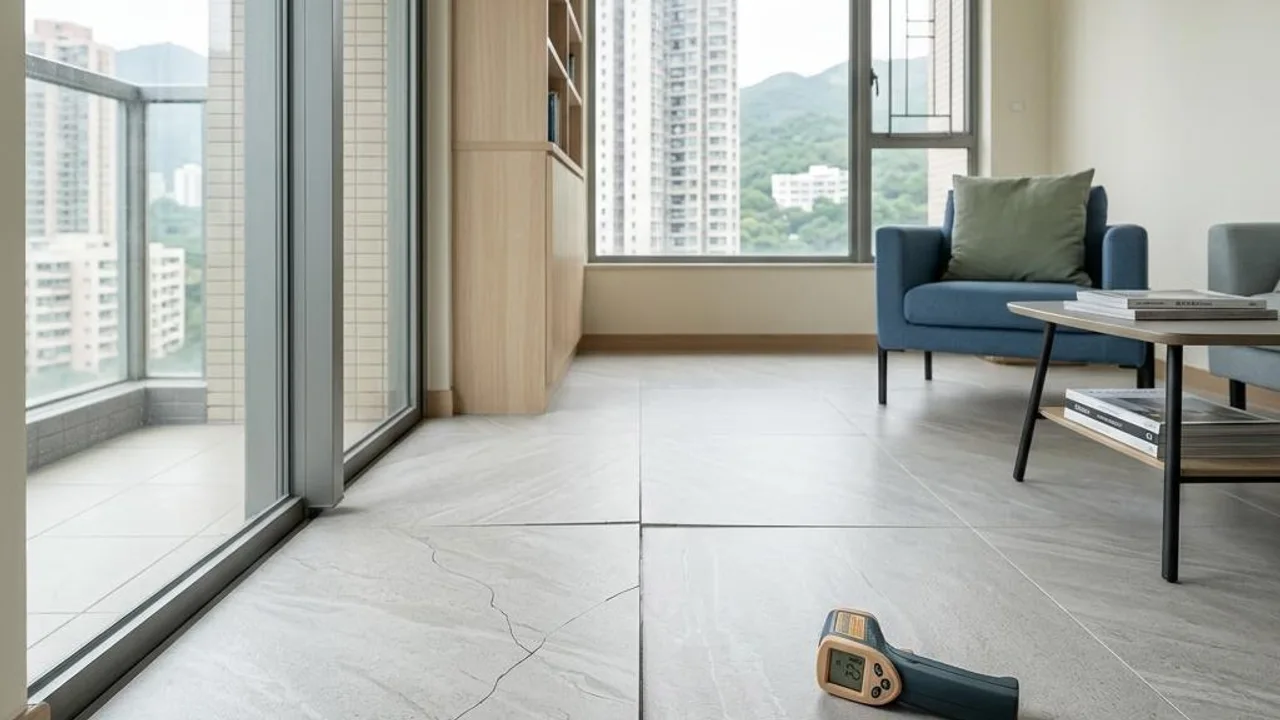
Hong Kong is located in the subtropics, and extreme weather poses a severe test to indoor flooring. Frequent switching of air conditioning in summer leads to drastic indoor temperature fluctuations, while the spring 'Return of the South' season causes air humidity to reach near saturation, keeping floor tiles in a long-term stress cycle of moisture expansion and dry contraction. When renovation workers do not reserve sufficient expansion gaps, floor tiles are squeezed by expansion stress, and if there is a lack of buffer space, stress will accumulate between the tile joints.
When the accumulated squeezing pressure exceeds the bearing limit of the cement mortar layer, the floor tiles will suffer shear failure. Common phenomena include damage to tile levelness, tile surfaces arching and cracking along the joints, and even triggering a chain reaction of damage to surrounding tiles. Many homeowners mistakenly believe in the luxurious 'seamless' tiling method, ignoring the requirements of basic structural mechanics on material adaptability, leading to serious consequences.
- Buffer gaps should be reserved around floor tiles to cope with climatic expansion.
- The rate of stress accumulation accelerates significantly when the temperature difference exceeds 10 degrees.
- Space must also be reserved at the surrounding skirting boards to release thermal stress.
Analysis of the stress structure relationship between floor tiles, mortar, and floor slabs.
Tiles are high-hardness, brittle, rigid materials whose physical properties differ significantly from the underlying leveling layer and concrete floor slab. When indoor environmental temperature and humidity change, the expansion rates of tiles and cement mortar differ. If 'seamless' adhesion is forced, minor settlement or dry contraction deformation of the base structure will be directly transmitted to the tiles, causing edge chipping or delamination.
In standard tiling logic, grouting is not only for aesthetics but is a key medium for elastic buffering. Through grouting, the system can effectively disperse structural shear stress and avoid concentrating squeezing in one direction at the tile joints. Understanding this layer of physical structural science is key to identifying professional tiling engineering versus shoddy work.
- Tiles have high hardness and low ductility, and cannot absorb structural displacement.
- The expansion coefficient difference between the base layer and the decorative material must have reserved space.
- The elastic buffering function of grouting is the key to ensuring durability.
Standard expansion gap acceptance and construction advice.
When conducting floor inspections, the width of the expansion gap is a key observation indicator. According to common engineering standards, 600 to 800 mm specification floor tiles should reserve at least a 2 mm elastic expansion gap to ensure the tiles have enough physical space for thermal expansion and contraction. For large-format sintered stone slabs, the gap needs to be adjusted appropriately; be sure to avoid following seamless advice of less than 1 mm.
Homeowners can use a standard gauge to check joint uniformity. Meanwhile, pay attention to the 5 to 8 mm peripheral expansion gap required under the skirting boards along the walls. Additionally, if a hollow sound occurs when knocking on tiles, be alert to potential delamination. Do not blindly pry up tiles; consult professional OPO Inspection personnel for assessment and handling.
- When laying floor tiles, it is recommended to reserve appropriate expansion gaps according to the tile size and material, usually at least 2 mm to cope with thermal expansion and contraction, reducing the risk of hollowing or tile popping later. This advice is for reference only; actual construction should be assessed by professional masters based on the site environment and product instructions.
- To avoid cracking caused by thermal expansion and contraction, it is recommended that the joint width for large-format sintered stone slabs be reserved at 2.5 to 3 mm. The inspection provided by this website is only a visual inspection of surface conditions and cannot guarantee structural strength or material durability.
- It is generally recommended to leave a 5 to 8 mm concealed gap around the perimeter of the floor as a buffer space to prevent tile popping caused by thermal expansion. This is a general observation reference, not an absolute guarantee that no structural problems will occur, and does not mean that the concealed layer or wall structure has been inspected. If floor tile abnormalities are found, it is recommended to consult a registered professional for assessment.
- Use tapping tests to check for hollowing; do not force pry tiles yourself.
Comparison of tiling methods and risk assessment.
Tiling methods on the market have profound impacts. Although 'seamless' adhesion achieves ultimate levelness in appearance, it is extremely prone to cracking in the Hong Kong climate, and subsequent repairs are difficult and costly. Conversely, standard elastic expansion joints, while leaving dividing lines, provide the best crack resistance and stress release capabilities.
Choosing the right method requires balancing aesthetics and practicality. Proper micro-joint resin grout can take into account both aesthetics and stain resistance, but you must confirm the leveling tolerance of the tiles themselves before construction. In summary, structural safety should take precedence over visual effects, and it is vital to ensure that every independent space has complete boundary joints.
- The 'seamless' adhesion method is a high-risk construction method and is strongly recommended to be avoided.
- Standard elastic expansion joints are the best option for anti-stress fissure.
- Resin grout is suitable for environments that need to balance cleanliness and elasticity.
- Ensuring boundary expansion joints is a mandatory supervision item for tiling acceptance.
The importance of a professional OPO Inspection team.
Tile arching after moving in is often difficult to repair immediately, not only affecting living quality but potentially causing accidental injury to family members. Hidden hollowing or structural defects in floor tiles before moving in are often hard to judge with the naked eye. Commissioning an experienced team to conduct precise inspections when taking possession can help homeowners prevent potential bursting risks.
Professional personnel can evaluate mortar bonding and overall levelness from a professional perspective. Through scientific instrument analysis of floor structural problems, it not only helps you request repairs from the developer during the handover stage but also provides the most solid guarantee for your long-term living environment, allowing you to enjoy your home life with peace of mind.
- Assist homeowners in discovering underlying tile defects early during the handover stage.
- Assess construction quality and structural safety to avoid long-term hidden dangers.
- Provide professional repair advice for discovered risks.
Frequently Asked Questions.
Q1: If tapping tiles reveals hollowing (hollow sound), will they definitely pop? A1: Hollowing reflects a loss of adhesion between the tile and the base layer, and the risk of arching is doubled under pressure. It is recommended to check its scope; small local hollowing can be reinforced by injecting resin glue through micro-holes, but if the hollow area is large and the joints are insufficient, the risk of bursting is extremely high and it must be dealt with.
Q2: If tiles have already slightly arched, how can I deal with it in an emergency? A2: Firstly, isolate the area to avoid people stepping on it, preventing the tiles from breaking and causing injury. Then, carefully remove the overly hard grout around the edges to release internal lateral pressure and gain space for subsequent removal. It is recommended to contact a professional repair master as soon as possible for assessment; do not force step on them.
Q3: Why does the property inspection officer pay special attention to the gaps at the corners of floor tiles? A3: Factory tiles have slight warping tolerances. If there are no sufficient expansion gaps during laying, the corners will produce 'uneven levels', forming collision points. When expanding due to heat, these protrusions are easily sheared and shattered, which is a typical cause of structural damage.
- Risk assessment of hollowing and bursting must comprehensively consider the gaps and damage area.
- Emergency handling should prioritize stress release rather than simple reinforcement.
- Controlling tile warpage is the core indicator for avoiding edge shear.
FAQs
If tapping tiles reveals hollowing (hollow sound), will they definitely pop?
Hollowing reflects a loss of adhesion between the tile and the base layer, and the risk of arching is doubled under pressure. It is recommended to check its scope; small local hollowing can be reinforced by injecting resin glue through micro-holes, but if the hollow area is large and the joints are insufficient, the risk of bursting is extremely high and it must be dealt with.
If tiles have already slightly arched, how can I deal with it in an emergency?
First, isolate the area to prevent personnel from treading on it and to stop the floor tiles from cracking or cutting anyone. Subsequently, you can carefully remove the overly rigid grout around the edges to release internal horizontal pressure and create space for the later removal. We recommend contacting a professional maintenance technician as soon as possible to assess the situation; do not attempt to tread on it forcefully.
Why does the OPO Inspection surveyor place special emphasis on gaps at the edges of floor tiles?
Factory-produced tiles have tiny tolerances for warping; if there are insufficient expansion joints during installation, the edges will create uneven levels, forming contact points. When subjected to heat and expansion, these protruding points are extremely prone to shearing and cracking, which is a typical cause of structural damage.