
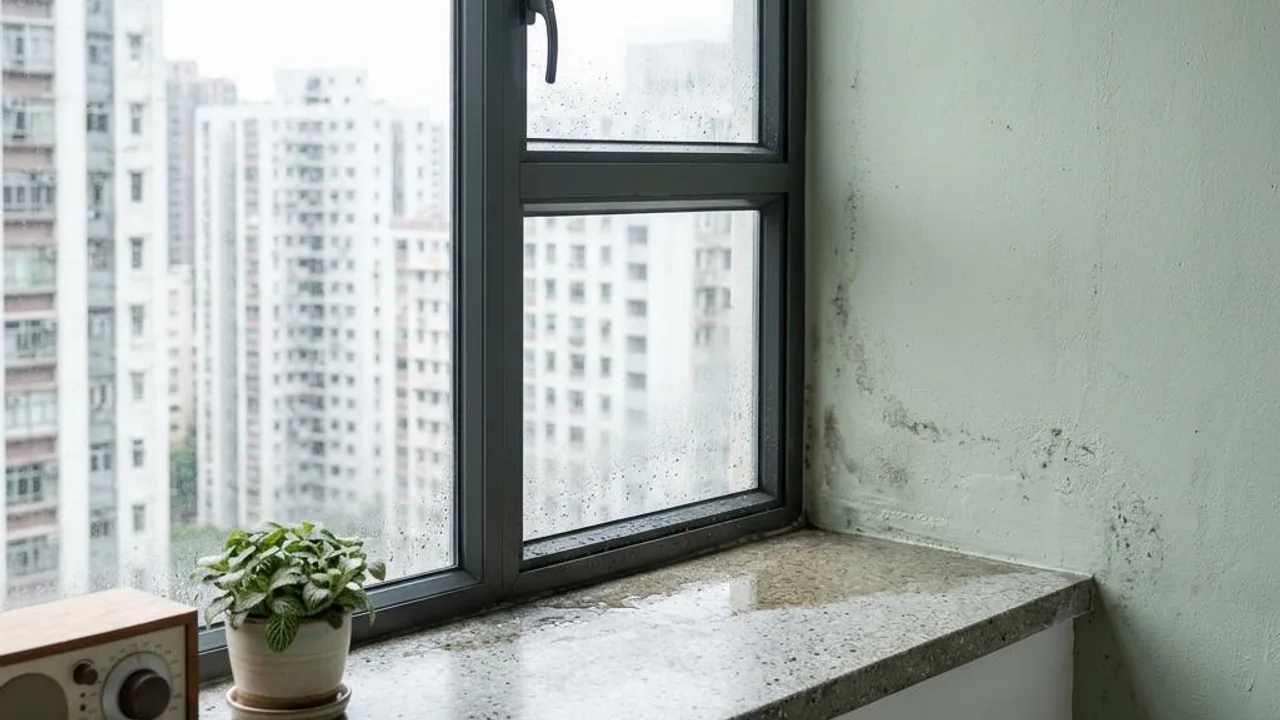
Prioritise safety, do not operate in wind and rain
When observing at windows, safety must be the priority. If water marks are found at windows, first ensure personnel are away from slippery floors and electrical equipment to prevent slipping or electric shock risks. If signs of looseness, cracks, or damage to window sashes, glass, or related accessories are observed, please stop any operations immediately, avoiding forced opening or closing of windows, so as not to aggravate the damage or cause accidents.
All observation activities must remain within safe indoor areas. It is strictly forbidden to climb onto window sills, stick your body out of the window, or frequently open and close windows in strong winds and storms just to photograph water marks. These behaviors are not only high-risk but also cannot provide effective inspection data in severe weather. Do not attempt any further inspection actions until you have confirmed the environment is safe and your own status is stable.
- Ensure the floor near the window is dry and away from power sockets
- Check window sashes and hardware for looseness or deformation
- Do not climb on window sills or stick your body out of the window
- Windows should be kept closed in strong winds
Make detailed records of weather conditions and window status
Accurate recording is the basis for dealing with water seepage problems. Be sure to note the specific time the water marks were discovered, the weather conditions at the time, and whether the window sashes were closed or open before discovery. Indoor environmental factors are equally critical, such as whether there are cleaning activities nearby, air conditioner condensate dripping, or other water usage; these may cause the surrounding environment to be damp and should be recorded together for analysis.
Remember, just finding water marks after rain does not mean you can directly determine that the exterior wall waterproofing layer or window frame rubber seals have failed. The cause of water seepage is complex and may involve multiple factors. Please maintain an objective recording habit and do not jump to conclusions without professional assessment. Objectively record the phenomena and let professionals determine the cause, which can solve the problem more efficiently.
- Record the specific date and time when water marks were discovered
- Confirm the general weather and wind conditions before and after discovery
- Check the position of the window latch and the degree of tightening
- Note if there is any influence from nearby air conditioners or cleaning water
Systematic location recording with photos
When taking photos as records, adopt the principle of 'overall first, then partial'. First, record the full view of the entire window to ensure it can be identified which room and position it is, then take close-up shots of areas where water marks appear, such as window sills, window corners, joints between window frames and walls, and skirting boards or cabinet edges. Photos should be clear and filter-free to truly reflect the situation.
To facilitate comparison later, it is recommended to note the date on the photos. Avoid conflating old water marks with newly appeared water droplets. If conditions allow, also mark the window orientation corresponding to the photo to help relevant personnel quickly lock in the position. Good photo documentation is key to communication and can significantly reduce misunderstandings and speed up the handling progress.
- Photograph the full view of the window to indicate the location orientation
- Take close-up photos of water marks on walls, window corners, and joints
- Ensure photos do not use filters and record the date
- Distinguish old marks from newly appeared water droplets
Avoid self-testing or unauthorized repairs
To prevent the situation from worsening, please do not flush water extensively outside the window, use sharp objects to clear holes, or apply silicone sealant at will. These actions may not only damage window components but also compromise the original structure and even affect the safety of other units. If you need to perform water seepage tests or repairs, you must first have the scope of the inspection confirmed by the management office or relevant parties, and obtain the necessary permissions and operational arrangements.
General observations after rain are not equivalent to a high-pressure water jet test and cannot be used as the final basis for determining the source of water seepage. Conducting controlled testing requires professional equipment and safety measures; it is strictly forbidden for homeowners to operate such equipment themselves. If problems are found, they should be recorded and reported to the property management office so that a professional team can formulate a repair plan based on the actual situation. Do not attempt to deal with it blindly.
- It is strictly forbidden to flush water extensively without permission.
- Do not attempt to apply silicone sealant or clear drainage holes yourself.
- Do not dismantle or pry at window frames and connection points.
- Understand that post-rain observations cannot replace professional inspections.
Submit information clearly and request follow-up
When submitting information to the management office, developer, or contractor, it is recommended to present it in writing. The content should include the date of discovery, specific location, photo records, and a description of the phenomenon. Distinguish between 'observed phenomena' and 'suspected causes', and request that the other party confirms receipt of the information and provides a follow-up plan and timetable. Always keep all communication records.
If repairs involve external walls or common areas, the authority to handle them must be verified by the relevant parties, and homeowners need to patiently cooperate with coordination efforts. Clearly listing the safety measures taken and pending items can make communication more organised. If the other party does not respond, you should follow up based on your records to ensure that the issue is not shelved, thereby protecting your rights to maintain your home.
- Clearly list the date of initial discovery and subsequent appearances.
- Clearly mark the specific locations where water marks appear.
- Provide both panoramic and close-up photos for reference.
- Request in writing that the other party confirms and provides a solution.
Reinspection procedures after repairs
The completion of repair work does not mean that the water seepage problem has been completely resolved. After repairs, please continue to observe and record the condition of the windows under different weather and wind conditions. A lack of seepage after a single rainfall does not mean it has been fully repaired under all climatic conditions; it requires the test of sustained rainfall to confirm effectiveness. General inspections cannot guarantee structural safety, the performance of waterproof layers, or long-term durability after the works. In the event of persistent seepage, please consult a professional contractor or qualified person for assessment; do not dismantle window components or perform dangerous high-altitude work yourself.
If water seepage reappears after repairs, you should continue to use the original reference number or report for follow-up; do not open a new report that disconnects from previous data. Maintaining a coherent record file allows repair personnel to more accurately analyse whether the problem has been fundamentally improved and reduces the time and communication costs of repeated inspections.
- Confirm the conditions and timing for post-repair observations.
- Maintain records of normal usage under different weather conditions.
- Perform continuous tracking rather than closing the case after a single observation.
- Use the old reference number to handle unresolved issues.
FAQs
If you receive an electronic inspection report and find errors or parts you do not understand, how should you handle it?
Please treat the report as a reference record and inform the issuing unit in writing of the clarifications needed based on actual observations, while also noting the discrepancies between your observations and the report's content to serve as a basis for subsequent follow-up.
Why can't water seepage appearing after repairs be treated as a new case?
If water seepage reappears after repairs, this is usually considered a continuation of the original repair plan. Using the original case number ensures that repair personnel can access the complete history, avoids redundant inspections, and helps analyse whether the previously adopted repair solution met the standard.
Can I hire a professional to conduct an inspection and submit a report to the management office myself?
Homeowners have the right to appoint professionals to investigate, but should consult the management office about procedures for entering common areas for inspection before acting. Note that electronic inspection reports usually do not include photos; it is recommended that homeowners take and keep their own site photos as supplementary information for communication with the management office.