Causal mechanisms of tile hollowness
Tile hollowness refers to the failure of tiles to bond tightly with the concrete substrate of the wall or floor, creating internal gaps. Such problems are common during construction, for example, due to unbalanced mortar ratios, inadequate cleaning of the base layer, or insufficient pressing techniques during tile laying. If the environment is too dry during construction, causing moisture in the mortar to dissipate too quickly, it will also lead to shrinkage and form a void layer.
Hong Kong's climate has large fluctuations in humidity, and wall materials are significantly affected by thermal expansion and contraction. If there are hollows inside, tiles cannot bear stress evenly, making them prone to bulging, loosening or even cracking under long-term use. If owners notice abnormal sounds from tiles, they should be aware that this is a warning of abnormal physical stress release and need to assess whether further action is required.
- Improper mortar ratio during construction
- Excessively fast moisture evaporation from plastering
- Insufficient pressing technique when laying tiles
- Physical stress induced by ambient temperature and humidity
Hollow location and structural safety assessment
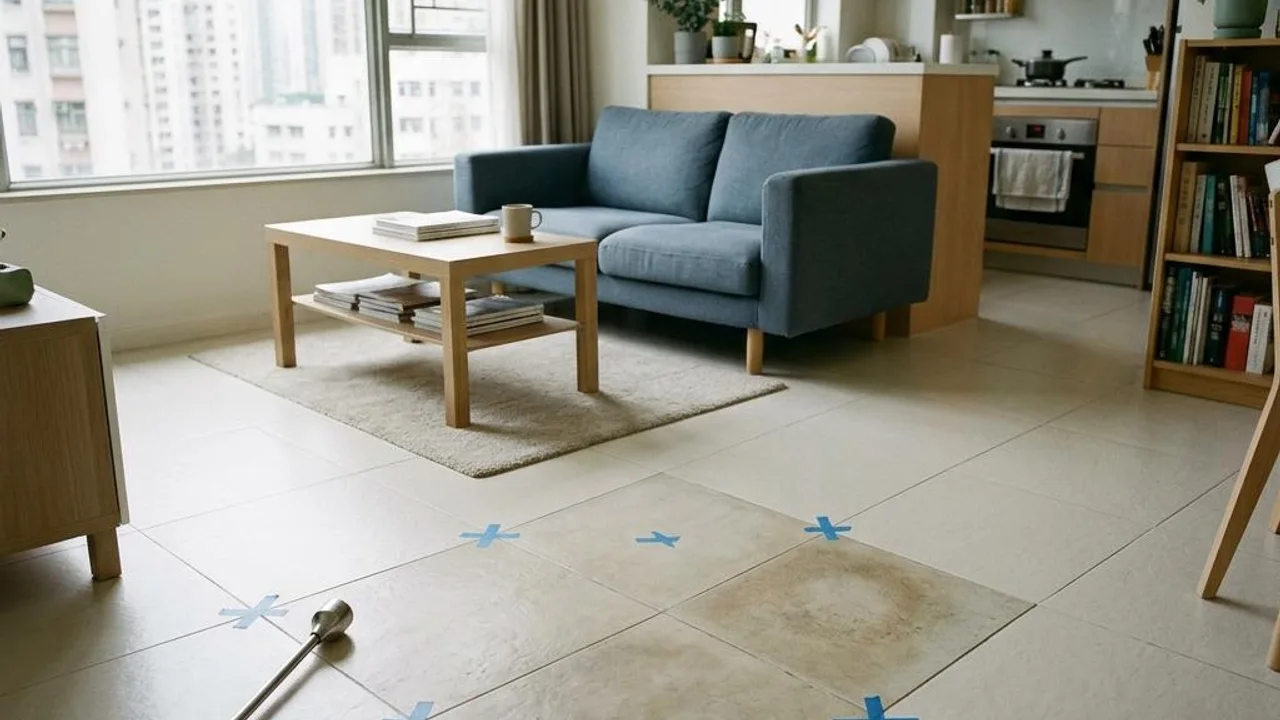
The focus when assessing whether tiles must be removed and relaid lies in the location and continuity of the hollows. Hollows at the edges or corners of tiles are prone to spreading after being subjected to stress due to a lack of surrounding anchorage, which in turn leads to detachment over a larger area. If multiple continuous tiles appear hollow, the stability of the base layer will be significantly reduced; such areas are key items for defect rectification.
If a hollow is only in the centre of a single tile, and the edges are firmly bonded, the structural risk is usually lower in the short term. However, the OPO Inspection criteria will calculate the statistics based on the ratio of the hollow area to the entire tile. If the hollow ratio is significant, even if there is no surface damage for the time being, there is a risk of detachment in the long term; it is recommended to include it in the priority repair list.
- Edge or corner hollows have a higher risk of spreading
- Relaid should be considered if more than 50% of a single tile is hollow
- Multiple consecutive hollows will reduce the stability of the base layer
- Small hollows in non-load-bearing areas can be handled according to the situation
Impact of area function on repair standards
Testing standards for areas frequently in contact with water such as kitchens, bathrooms, and shower areas should be strictly enforced. Once there are hollows in these locations, moisture can easily penetrate through the tile joints to the back, causing the internal plastering layer to become pulverised or peel off, and may even leak into the units below, causing more serious structural damage. Such hazards should be prioritised during inspection.
For general living room or bedroom walls, if they are only minor and scattered hollows, owners can consider using a grouting repair method without affecting the appearance. Grouting can effectively fill internal gaps and improve adhesion, while avoiding the vibration caused by large-scale removal works and reducing potential secondary damage to the original finish and waterproof layer.
- Kitchen and bathroom areas require strict assessment
- Water seepage can lead to pulverisation of the plastering layer
- Grouting repair is suitable for minor, non-spreading hollows
- Avoid unnecessary removal works
Weighing time costs and economic benefits
When performing defect rectification, owners should weigh the disturbance caused by the works against the actual cost. Blindly pursuing 'zero hollowness' may lead to high tiling work costs, and the mechanical vibration during the tile removal process may affect other intact parts of the wall. Owners should distinguish between 'must relay' and 'recommended repair' categories based on professional advice, rather than redoing everything.
A defect rectification plan formulated based on a professional inspection report can help owners prioritise repairs. This not only saves unnecessary financial and time expenditure but also ensures the rectification process proceeds in an orderly manner while safeguarding safety. Allocating resources reasonably to balance project benefits and quality of living is the core approach to scientifically dealing with hollowness.
- Measure the hollowness ratio to determine priority
- Compare the economic benefits of relaying vs grouting
- Assess the impact of removal works on surrounding structures
- Plan the defect rectification list based on the professional inspection report
Role and function of professional inspection
Although owners can tap the walls themselves to identify whether there are hollows, it is difficult to accurately grasp the area ratio of the hollows, let alone judge the bonding strength of the underlying plaster or hidden leakage risks. OPO Inspection inspectors use professional equipment to perform whole-house statistics, which can provide objective data references for defect rectification, which is crucial for communicating with developers and striving for reasonable repair arrangements.
A complete professional assessment report is usually provided on the working day after the inspection. Electronic reports do not include photos; owners can record specific locations based on the report's instructions. Through professional judgment and objective data, owners can effectively prevent secondary damage to the wall surface caused by blind rectification, ensuring that repair work targets the root of the problem.
- Use professional tools for comprehensive statistics
- Provide objective risk grading reports
- Assist in handling communication and disputes with developers
- Prevent secondary damage caused by blind rectification
FAQs
If I discover tile hollowness at home, must I immediately relay them?
Not necessarily. Whether to relay depends on the specific location of the hollow, the area ratio and the function of the area. If the hollow is at the edge and the area is large, it is recommended to relay; if it is only a minor hollow in the centre, consider grouting repair to avoid major works.
Why does the issue of hollowness in kitchens and bathrooms need special attention?
These areas come into frequent contact with water. If there are hollows, moisture easily penetrates behind the tile layer, leading to pulverisation of the plaster, and may even cause leakage risks, so they must be strictly handled during inspection and defect rectification.
What is the follow-up maintenance process after finding hollowness in the property inspection report?
After the property inspection, you will receive an electronic report (no photos attached, owners can record them themselves). Owners can categorise items that must be relayed or recommended for repair based on this, and communicate with the contractor to arrange repairs. Please note that reinspection is usually an independent service and is not included in the first property inspection.