Understanding the material properties of quartz.
Quartz is a crystalline composite material formed by natural quartz sand, high-performance resin, and pigments under vacuum and high pressure. Quartz granules provide excellent hardness and scratch resistance, while resin fills the pores, enhancing stain and water resistance.
When inspecting, one must understand its physical limitations: quartz is not purely natural stone. When the surface frequently comes into contact with extremely hot cookware, if the resin component is of poor quality, or if stress concentration leads to uneven expansion coefficients, micro-cracks or deformation may occur.
- Quartz possesses extremely high scratch resistance.
- Resin content determines the resistance to penetration.
- Composite structures require attention to drastic temperature changes.
Thermal shock and surface flatness inspection.
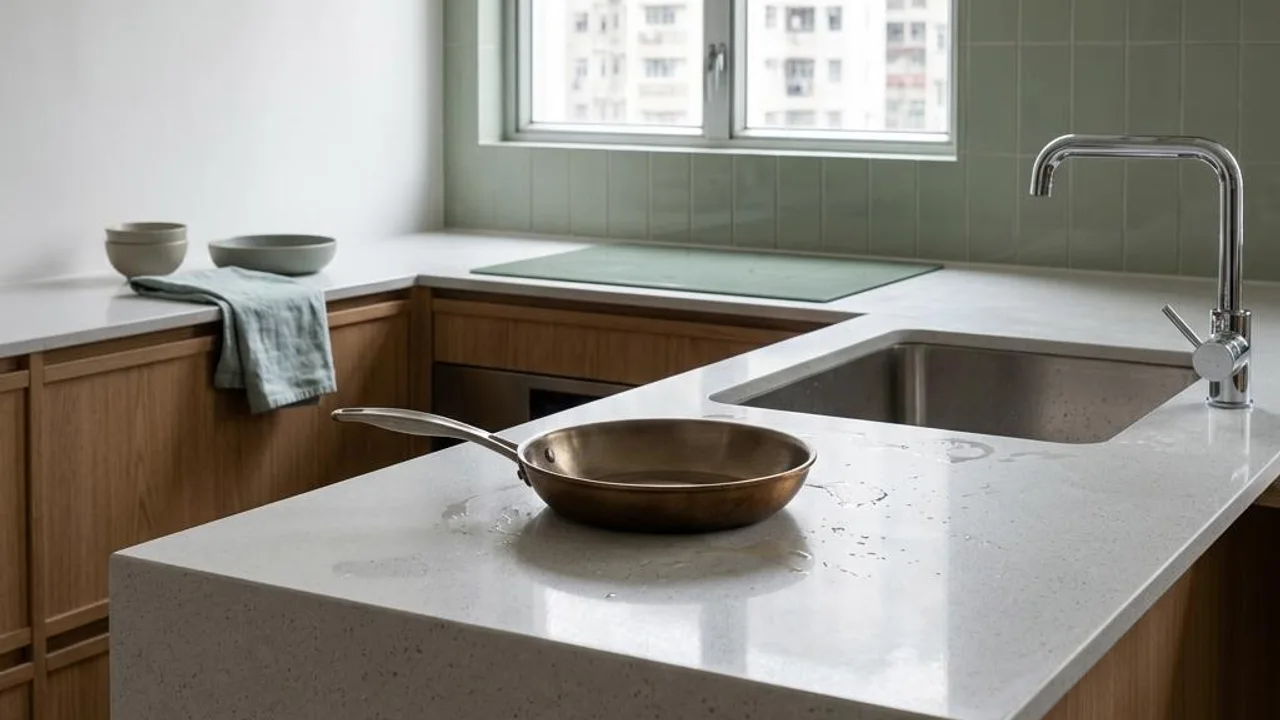
Most common cracks in kitchen countertops stem from thermal shock, which is the severe local temperature difference caused by placing high-temperature utensils on a cold countertop. Inspection focuses on the areas around stove cut-outs, seams, and sink corners, where physical stress is most concentrated.
Professionals will check whether the cut-outs have been processed with rounded chamfers and confirm that reinforced supports are sound. Through a comparison of flatness and gloss, one can preliminarily judge whether the material has potential construction flaws, preventing cracks during future use.
- Check if the cut-outs for the cooking stove have rounded chamfered edges.
- Inspect the joints for signs of uneven stress.
- Observe whether the surface gloss is consistent and free from defects.
Long-term usage and preventive maintenance.
Although quartz can withstand everyday cooking temperatures, as a prudent homeowner, you should still take precautions. After installation, maintain good daily habits, such as keeping heat mats or trivets on the countertop to reduce the chance of direct contact with high heat.
Long-term exposure to extreme heat can cause cumulative microscopic damage to the resin structure. Good preventive guidance ensures the quartz countertop retains its gloss and structural integrity, enhancing the aesthetics of the kitchen and the long-term value of the property.
- Use heat mats or trivets when cooking.
- Avoid placing boiling pots directly on the stone surface.
- Regularly inspect joint areas for any signs of cracking.
Professional inspection and assessment methods.
Relying solely on visual inspection of the countertop makes it difficult to detect hidden stresses at cut-outs or stability defects in the composite resin. Professional teams are equipped with infrared thermal imaging analysis and micro-crack detectors to scientifically quantify the structural fit and heat distribution of the countertop.
Professional inspection can provide an objective data report without disrupting the current status. Through expert verification, homeowners can precisely eliminate the risk of thermal cracking, ensuring that the kitchen renovation project meets high-quality standards and guaranteeing the safety of the daily cooking environment.
- Use infrared thermal imaging to analyze heat dissipation uniformity.
- Use professional equipment to detect hidden physical stresses.
- Obtain an objective and accurate inspection data report.
Daily cleaning and care essentials.
For daily cleaning, use a neutral detergent and a soft cloth. Avoid strong acidic or alkaline cleaners, as these may damage the resin components on the stone surface, leading to a loss of gloss or patchy discoloration.
If accidental liquid spills occur on the countertop, wipe them up immediately. While quartz is resistant to staining, long-term pigment sedimentation can still affect the visual appearance of lighter-colored stone surfaces.
- Use neutral detergent with a soft cloth.
- Avoid using steel wool or abrasive cleaners.
- Clean up spills of colored beverages immediately.
FAQs
Why do cracks easily form around the stove cut-out on quartz countertops?
The area around the stove cut-out is subject to greater stress due to the machining involved. Additionally, its proximity to the heat source of the stove makes it prone to thermal shock. If the edges of the cut-out have not been rounded/chamfered, stress concentration may trigger cracking.
What should a homeowner do if they discover fine cracks on the countertop?
First, stop placing heavy objects or high-temperature utensils on the area, and document the location and shape of the cracks. Contact a professional to conduct an infrared scan to assess whether the cracks were caused by installation stress or thermal damage; do not attempt to repair them yourself.
Are quartz countertops completely heat-resistant?
No. Quartz contains a certain proportion of resin and is not absolutely heat-resistant. Long-term contact with hot pots can cause microscopic damage to the resin or lead to uneven thermal expansion and contraction. It is highly recommended to use heat mats to protect the structural integrity of the countertop.