
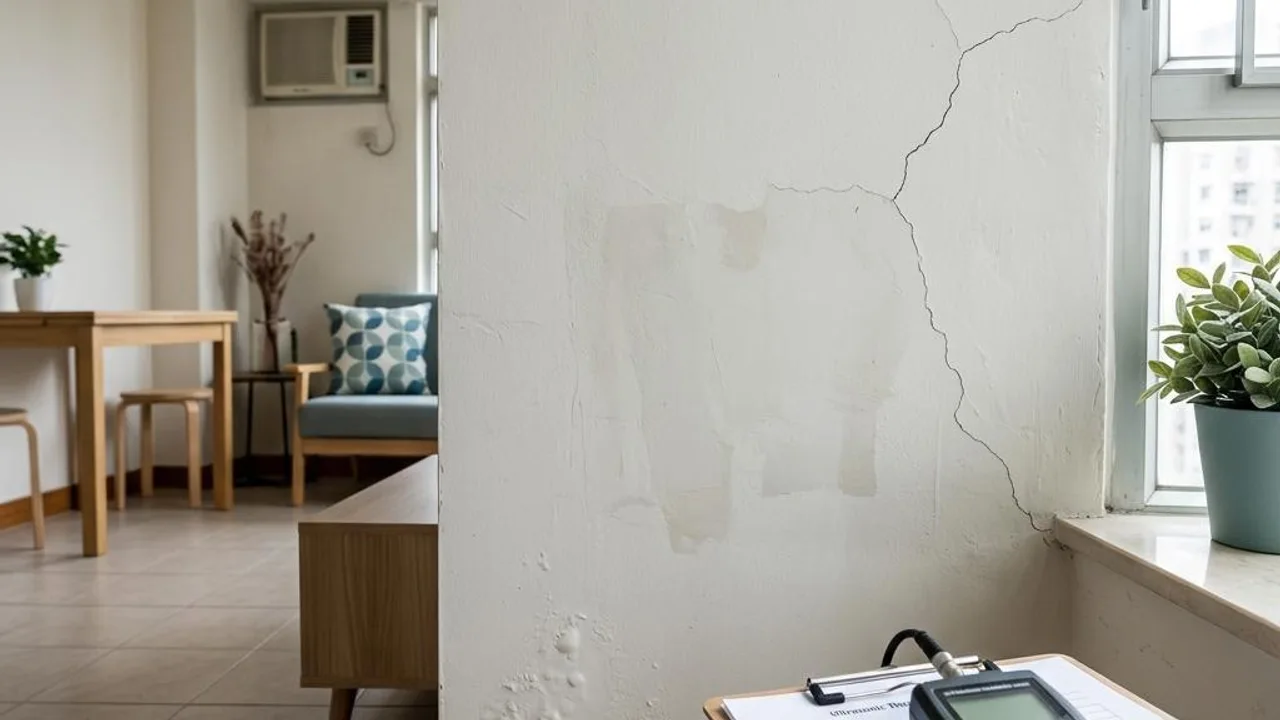
Primary conditions for wall observation: Light source and viewing angle.
When carrying out wall inspections, the choice of lighting is crucial. Natural light, indoor lighting, and side lighting create vastly different effects on the appearance of the surface texture, which directly influences your perception. It is recommended that owners conduct an overall observation from the perspective of daily living before recording, and must not over-rely on a single light source or a close-up shot from a single angle, to avoid visual misjudgment due to shadows or light contrast. At the same time, avoid evaluating while the surface is freshly cleaned or not yet completely dry.
When taking photos for your records, try to keep the shooting environment stable. It is forbidden to use any filters or post-processing colour adjustments, as this will prevent the paint colour difference from being authentically restored and will interfere with the precision of subsequent repairs. The correct approach is to select standard lighting and take shots of both the overall range of the wall and the specific defect locations, providing the most objective visual reference data for engineering staff.
- Ensure the wall is dry and free of cleaning residues before assessment.
- Record the light source type and environmental conditions when taking photos.
- Combine overall wide-angle shots with local close-ups.
- Avoid using any filters to edit photos.
- Conduct multiple comparison shots from fixed positions.
Recording defects by item: Say no to vague paint issues.
Many owners often label wall defects generally as 'poor paint', which is unhelpful for subsequent cause analysis and repair. In fact, colour differences, brush marks, blistering, peeling, chalking, and surface stains each correspond to different construction procedures or environmental causes. When recording, clearly label the spatial zone where the defect is located, its distance from doors, windows, and corners, and retain a long-range photo of the entire wall so that the engineering team can quickly locate it and carry out a professional assessment.
In addition to appearance descriptions, you also need to summarize the timeline of when the defect occurred and its history. For example, whether that location has had water seepage repairs, cleaning, or repainting before, and what the source of the relevant information is. If the wall involves recent repair works, you must record the completion date provided by the engineering party and the expected reinspection date; this effectively distinguishes whether it is an old issue that has not improved or a newly emerged construction defect.
- Mark the location of the defect relative to the room orientation, doors, windows, or corners.
- Differentiate between physical phenomena like colour difference, blistering, and chalking.
- Record whether the location has a past repair history.
- Collate the completion dates and follow-up commitments provided by the construction party.
Observation and management of cracks: Strictly forbidden to handle blindly yourself.
Wall cracks are a common concern in home maintenance, but you should remain calm when observing them. Owners need to accurately record the starting point of the crack, its specific direction, and the range of the wall involved. To facilitate comparison of changes, you may place a scale bar next to the crack and take a photo without causing any damage to the wall, allowing engineering staff to track and compare them later. Never chip, scrape, or inject materials yourself for the sake of observation.
It must be emphasized that you absolutely cannot determine whether wall cracks involve structural safety based on the thickness of the crack or general home experience. If you observe signs that the crack is expanding or are worried about structural risks, seek professional assessment immediately. The owner's job is to provide accurate observation records, not to replace professional structural inspections. Before professional advice is provided, avoid taking any excessive intervention measures that might affect the state of the wall surface.
- Record the specific direction and length changes of the crack.
- Use a scale bar when taking photos to facilitate long-term comparisons.
- Forbidden to perform cutting or destructive attempts during the observation period.
- Retain the initial discovery date to observe the frequency of changes.
- Seek assessment from qualified professionals when safety concerns are involved.
Water stains and blistering: Combining timelines with environmental conditions.
Water stains, blistering, or plaster flaking on the wall are often related to moisture; these phenomena may appear with varying degrees of change after rain, water usage, or air-conditioning operation. When recording, these changes must be linked to specific dates and environmental conditions. Avoid using new paint to cover the marks before an investigation; this will prevent professionals from observing the original state of the defect and will not help in finding the source.
If you find loose materials on the wall, continuous water leakage, or if the issue location is near electrical sockets or wiring and other electrical equipment, prioritize home safety. At this point, do not delay action just to keep an on-site record; inform the professional repair unit or management office as soon as possible, and simultaneously submit the relevant observation records after emergency handling for reference during subsequent investigation and repair.
- Record changes in water stains against weather factors like rainy days.
- Retain comparison records of the defect location before and after water usage.
- Prioritize handling and reporting immediately when electrical hazards are discovered.
- Refuse to cover defects with paint before the cause is identified.
Professional strategies for phenomenon description and maintenance follow-up.
When submitting a problem report to the engineering team or management office, precise 'phenomenon descriptions' are superior to 'proposed solutions'. For example, clearly pointing out 'Blistering and water stains visible below the wall near the window in the master bedroom, and the recorded area has expanded after the rain compared to last time' is more helpful for investigation than demanding they 'redo the entire wall'. Storing your factual observations separately from their verbal explanations is crucial for clarifying disputes and demanding follow-up.
In addition, for situations where the cause cannot be determined, clearly stating 'Pending Investigation' is more professional than blind speculation. Owners should request the responsible party to confirm the investigation steps and the expected repair timeline. Please be reminded that performing a surface paint touch-up does not mean the underlying potential factors of the wall have been resolved; owners should retain these records until the defect has completely disappeared and the observation period has expired to ensure the engineering quality meets requirements.
- Use phenomenon descriptions to replace personal speculation.
- Keep observation records and third-party opinions separately.
- Clearly mark 'Pending Investigation' for areas where the cause is unknown.
- Require the other party to confirm specific arrangements for investigating the cause.
- Ensure the follow-up scope is not limited to surface paint repair.
The key to reinspection: Ensuring it does not deteriorate after repair.
Reinspection after engineering works should be carried out under the same light and viewing angle as the initial observation as much as possible. Owners should confirm a suitable inspection time with the construction party and compare the repaired area with the surrounding wall for colour differences, new cracks, or secondary damage caused by improper construction. The phenomenon not being visible to the naked eye within a short time does not mean the problem has been thoroughly resolved; you should lengthen the observation period and record the observation conditions and follow-up dates.
If the defect reappears after repair, you should continue using the initial issue number and attach the latest date and status record. This systematic approach allows subsequent reinspections to have a clear comparison and avoids difficulties in making warranty claims due to fragmented information. If the issue appears repeatedly after repair, the owner should examine the contract terms and the construction party's warranty commitment and timely request a more in-depth investigation of the cause rather than just performing surface smearing.
- Use consistent lighting and viewing position to compare before and after repairs.
- Check whether new damage has appeared around the repair.
- Establish a long-term observation mechanism rather than relying solely on completion sign-off.
- If the defect recurs, use the existing number to continuously update information.
FAQs
When wall cracks are discovered, can the owner fill them in themselves?
It is not recommended to fill them in yourself. Owners should first record the direction, length, and discovery date of the crack, use a scale bar to take photos as evidence, and observe if there is a trend of deterioration, rather than performing actions like cutting, chipping, or injecting materials that would affect the original state of the wall. Wait for professionals to assess the cause.
If the paint colour after repair is inconsistent with the original wall, how should it be handled?
First, you should use the same light and viewing angle as in the initial observation record at a suitable time coordinated with the construction party. If a clear colour difference exists, treat it as a construction quality issue, follow up using the original defect number, and demand the construction party handle it according to contract terms and warranty commitments to ensure the colour touch-up meets expected standards.
Does wall blistering definitely mean there is a water seepage problem inside the wall?
Wall blistering or peeling paint is related to moisture and may indeed be linked to water seepage, but the specific cause must be determined by assessing the timeline and environmental conditions. For example, check if it worsens after rainfall, water usage, or air conditioning operation. Homeowners should record these changes and notify professionals for an investigation. Do not paint over the defects before confirming the cause, as this may hinder a professional diagnosis.