
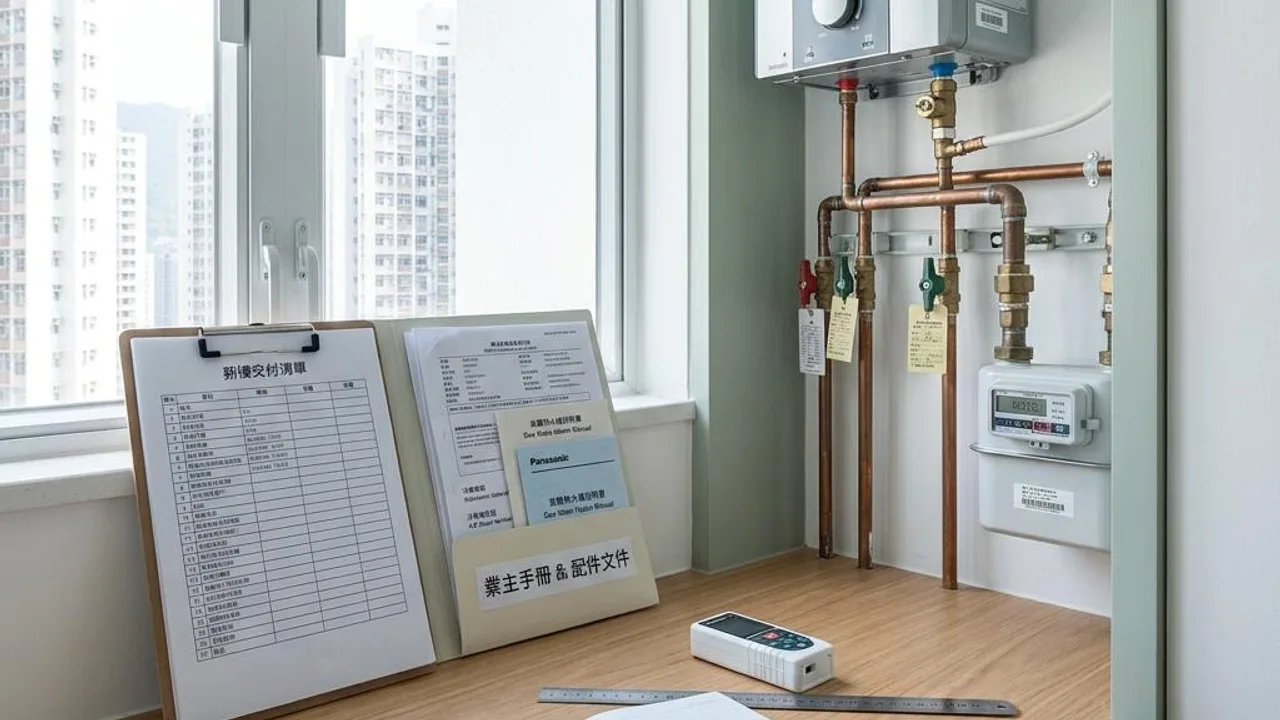
Prioritise the use of official documentation for the checklist.
When inspecting a unit, you must have the contract, sales brochure appendices, handover standard list, and any signed change documents directly relevant to that unit. Note that even in the same development, different layouts or phases may have different configurations. Online photos, show flat displays, or lists from other owners serve only as references and are not direct evidence for your own unit's handover requirements.
If information is ambiguous when checking documents, prioritise the official contract. If specifications were revised post-presale, ensure relevant written confirmations are prepared for comparison. Do not rely on non-official information to avoid a passive position when requesting follow-up from the developer due to insufficient evidence.
- Collate the contract and appendices corresponding to the unit.
- Confirm the handover list applicable to the unit's specifications.
- Refer to the official specification pages in the sales brochure.
List equipment by room; improper dismantling is strictly prohibited.
Adopt a zone-based inspection strategy, checking equipment location, quantity, and visible labels on the list room by room. During inspection, do not dismantle cabinet panels, force out embedded appliances, or move heavy objects to view model numbers. If equipment labels are obstructed or difficult to read, categorise them as 'to be confirmed' and request correct specification data from the responsible party.
This cautious approach not only prevents damage to the property but also ensures the objectivity of inspection records. If the name on the list differs from the label on the item, record it and inquire rather than assuming the equipment model is incorrect. Only proceed to performance testing once all items on the list have been verified in their correct locations.
- Check equipment locations and quantities room by room.
- Record equipment labels that can be safely read.
- Make a note of items that do not match.
Categorise and record three types of issues to improve communication efficiency.
To enable the developer to respond accurately, categorise issues into three types: missing items (listed but absent on-site), configuration verification (items present but model/specifications questionable), and functional abnormalities (discovered during operation). Each issue must be accompanied by unit location, corresponding document index, and a fixed serial number for follow-up tracking.
Do not label inaccessible equipment as 'defective'. If testing is impossible due to technical limitations (e.g., no authorisation to operate or water/power not connected), record it as inaccessible rather than misjudging it as damaged. Exhaustive, objective descriptions significantly reduce repair and administrative verification time, cutting costs associated with re-inspection due to misunderstandings.
- Categorise and record items as missing, to be verified, or abnormal.
- Every issue must be assigned a clear serial number.
- Descriptions should focus on objective observations.
Ensure handover is complete before asking about operation methods.
During initial appliance inspection, if items are uncommissioned, covered in protective film, or require settings by a designated technician, consult the developer's representative on proper operating methods and usage restrictions. Follow the principle of confirming handover completeness before evaluating functional operation. Do not force removal of protective seals, modify circuits, or test gas equipment yourself to avoid danger or compromising warranty eligibility.
Property inspection is not equivalent to initial appliance start-up and commissioning, which often involves supplier certification. Owners must clearly understand what is the developer's responsibility and what requires contacting the manufacturer. Avoid changing the factory state before everything is clarified to prevent unnecessary interference with property warranty terms.
- Confirm if equipment is ready for activation.
- Inquire about correct operating methods and safety restrictions.
- Inquire separately about equipment warranty registration procedures.
Handle documents and accessories separately to protect privacy and rights.
Check all accompanying accessories and manuals upon property collection to ensure they match the list exactly. Some manuals may contain warranty registration forms; check if these are complete, avoid revealing unnecessary personal privacy during registration, and keep originals in a safe place after registration.
For accessories such as cabinet keys, air conditioner remotes, or shelf dividers, check specifications and quantities one by one. If they do not match the list, note it immediately and request replacements. Establishing a comprehensive documentation handover record table helps owners effectively manage components within the property and avoid loss or confusion during occupancy.
- Check quantities of all manuals and accessories.
- Confirm warranty information and mask private data.
- Establish a comprehensive documentation handover record.
Cite contract terms and request formal written responses.
When equipment discrepancies are found, clearly provide the issue number, location, and corresponding checklist item to the responsible party. Demand commitment for replacement, inspection, or follow-up action, and record their responses in writing. If a dispute regarding contract interpretation arises, seek professional legal advice; do not treat property inspection records as grounds for contract arbitration.
Retain records of all communication and responses from the developer. The goal of property inspection is to make the unit's handover status transparent and provide a clear dialogue platform. Through factual statements and references to contract documents, owners can protect their handover rights within reasonable limits, preventing repair delays caused by ambiguous communication.
- Request follow-up by citing corresponding checklist numbers.
- Require the developer to provide written confirmations.
- Keep communication records safely as evidence.
FAQs
What should the owner do if they find the equipment model does not match the list during the property inspection?
The owner should first document the actual on-site markings and label the issue as 'Configuration Verification' to avoid making false assumptions or dismantling the equipment. They should request that the developer provide the official specification list for the unit to cross-check and confirm the discrepancy and the specific delivered model in writing.
Can I test the performance of all electrical appliances myself during the property inspection?
The focus of the property inspection is to verify the completeness of the delivery. If the equipment has not been powered on or factory settings have not been completed, you should consult the developer for the correct operation methods and safety restrictions; do not forcefully unpack or test it yourself, so as to avoid damaging the equipment or affecting the warranty terms due to improper operation.
If equipment is found to be missing on-site, how should it be recorded to protect my rights?
Missing items should be recorded and given a unique serial number based on the unit location and corresponding document index. Request the person in charge to sign and confirm the missing situation, and keep all written communication records as evidence for follow-up; do not rely solely on verbal inquiries.