
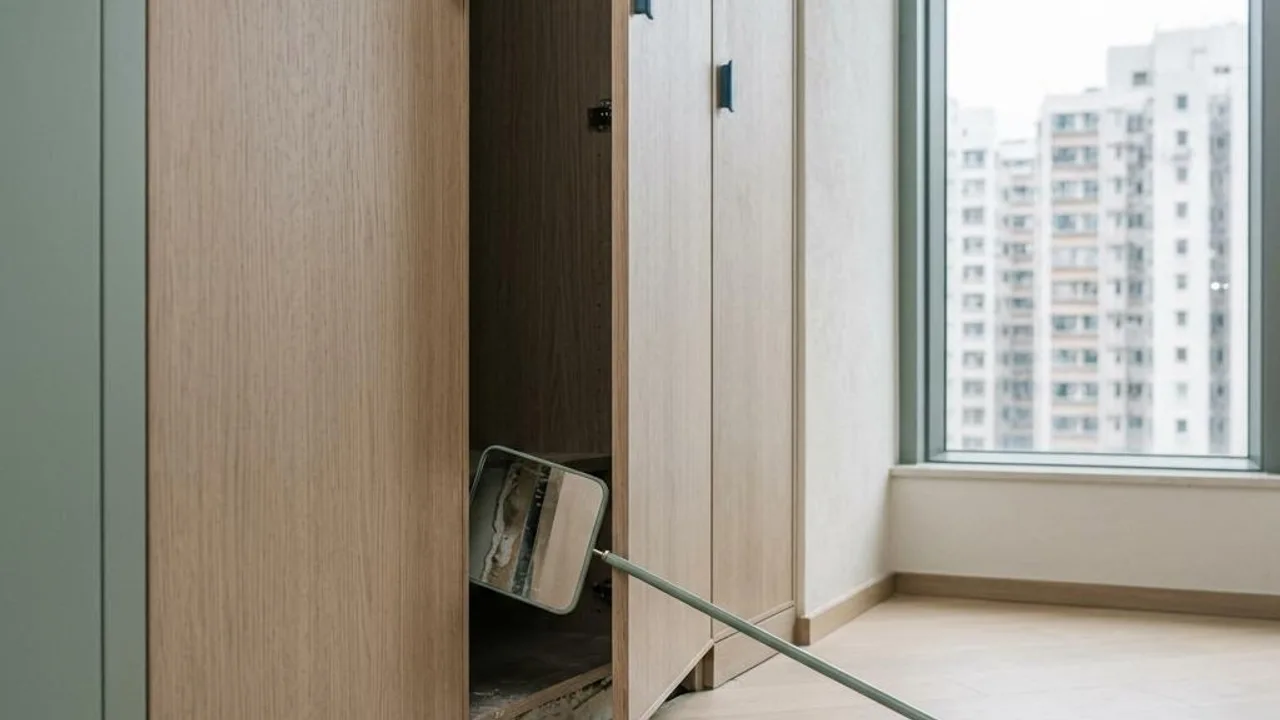
Why pay special attention to furniture seams during handover?
In recent years, new residential developments often include luxurious interior fit-outs and bespoke furniture to increase their appeal. Although aesthetically pleasing, these cabinetry units are often positioned flush against walls or floors, obscuring many structural details and increasing the difficulty for owners to inspect them.
When taking possession of a property, beyond assessing the design's aesthetics, owners should shift their focus to the joints where these furniture pieces meet the property's structure. Identifying hidden construction defects early helps avoid unnecessary defect rectification costs that may arise after moving in.
- Luxury cabinetry often conceals walls and floors. During property inspection, attention should be paid to the joints between the cabinet and the wall, as well as the internal structure; however, this inspection is limited by the visible range and cannot detect seepage inside the wall, the condition of concealed pipes, or structural safety. If abnormal water stains or irregular temperature differences are found inside the cabinets, it is recommended to consult a professional for further testing.
- The joint is a key indicator for observing the precision of furniture installation
- Identifying gaps early allows for requesting improvements from the developer, reducing future maintenance troubles
Sealing condition of joints between cabinet bodies and walls
Connections between furniture and walls or ceilings are typically finished with silicone (glass sealant). Owners should focus on checking whether the silicone sealant is applied evenly and continuously, and if there are peelings, cracks, or obvious gaps, as these are direct evidence of construction workmanship.
If the sealing is poor, subsequent changes in indoor temperature and humidity may cause the wooden cabinet structure to expand at the joints due to uneven stress. This not only facilitates the accumulation of dust and insects but may also allow moisture from seepage to enter the back of the cabinet more easily, leading to mould risks on the wall.
- Check whether the silicone sealant on the cabinet edges is applied evenly and smoothly
- Observe whether there is any peeling or cracking at the finishing positions
- Observe whether there are any abnormal gaps between the cabinet and the wall structure
- Confirm whether the sealing condition causes dust accumulation
Damp marks hidden behind cabinets and at trim edges
When large furniture is placed against a wall for a long period, if there is minor seepage from the external wall or waterproofing layer, moisture can easily accumulate behind the cabinet. It is recommended that owners use a high-intensity flashlight to inspect the bottom of the cabinet, the edges of mirror cabinets, and the sides against the wall carefully.
Special attention should be paid to signs of water stains, mould, discolouration, or swelling of the wood. These signs are often early warnings of micro-seepage within the wall structure; if identified at the beginning of the property handover, the developer can be requested to conduct a thorough investigation of the waterproofing layer; do not take this lightly.
- Use a strong light to check if there is any discolouration or swelling on the back of the cabinet or the flooring
- Observe if there is any mouldy smell or mould spots at the joints
- Check for water stains at the bottom of kitchen cabinets and under the washbasin
- Be alert for signs of dampness on the wall paint behind the cabinets
Furniture trim hardware and smoothness of openings
The durability of luxury furniture is closely related to the installation of hardware. During the property inspection, open all cabinet doors, drawers, and sliding doors repeatedly to test the smoothness of tracks and hinges, and confirm whether there is any abnormal noise, sticking, or collision.
Observe whether the lines are level and symmetrical after the cabinet doors are closed. If the door gaps are uneven or screws are loose, this suggests errors in installation positioning. The developer should be requested to make precise micro-adjustments and tightening during the warranty period to ensure that long-term use will not affect the opening and closing functions.
- Repeatedly test the smoothness of opening all cabinet doors and drawers
- Check if the door gaps are evenly aligned after the cabinet doors are closed
- Note any abnormal opening/closing resistance or metallic friction sounds
- Check if the hinge screws are tightened with no obvious deviations
Internal inspection of storage space and plumbing access points
The space under kitchen cabinets and washbasins hides water supply and drainage pipes. The focus of the inspection should be on the sealing treatment where pipes pass through the back panel of the cabinet, ensuring that gaps are properly filled to prevent liquids from seeping into the wooden cabinet structure.
Confirm whether all reserved inspection hatches or removable panels are easy to open. These access points are essential for future plumbing maintenance; if they are excessively sealed or improperly installed, it will be difficult to notice potential minor drips, increasing the difficulty of maintenance.
- Verify if the sealing of the water supply pipes passing through the back of the cabinet is adequate
- Confirm that inspection hatches and removable panels can be opened normally
- Check for obvious signs of leakage around pipe connection points
- Ensure that the ventilation and waterproofing inside the cabinet meet daily needs
The blind spots and limitations of self-inspection
Although owners can inspect the surface with the naked eye and simple tools, examining the plastering of the wall behind the furniture, deep structures, and concealed electrical circuits is often beyond the capacity of the naked eye. Without the assistance of instruments, it is difficult to penetrate the wooden boards to test the actual construction quality behind them.
Furthermore, regarding doubts involving structural safety, owners should understand that visual inspection does not equate to structural verification. If significant hazards are encountered, do not attempt to handle them alone or make blind judgements; instead, seek professional advice and accurately record the problems as a basis for negotiations with the developer.
- It is difficult for the naked eye to assess the plastering and waterproofing details of the wall behind the cabinet
- Without professional moisture meters, it is difficult to confirm the dampness condition inside the structure
- Hidden electrical circuit safety cannot be viewed without dismantling
- Professional knowledge is required to judge whether defects pose structural risks
FAQs
How should you deal with water stains discovered behind a cabinet?
Owners should maintain the status quo and immediately take photos for documentation, clearly marking the affected area and position of the cabinet, then notify the developer's property management office, requesting them to arrange for professional personnel to inspect the waterproofing layer and relevant pipe connections behind the wall; do not attempt to repair or dismantle the cabinet yourself.
Is an uneven gap in cabinet doors discovered during inspection a structural issue?
Uneven cabinet door gaps generally fall under the scope of furniture hardware installation and adjustment, rather than a building structural issue. Owners can request the developer to adjust the hinges to ensure smooth opening and closing and alignment of door panels; during property inspection, verify that the hardware operates stably after adjustment with no abnormal friction sounds.
Why should you not dismantle cabinets yourself to inspect the wall behind them during property handover?
Self-dismantling may lead to damage to the furniture or loss of original manufacturer warranty, and it also involves risks to concealed electrical circuits and pipes. Owners should observe visible joints and marks inside the cabinet with the naked eye; if deep-seated seepage is suspected, request OPO Inspection professionals equipped with suitable instruments to conduct the test and have the developer handle it.


