
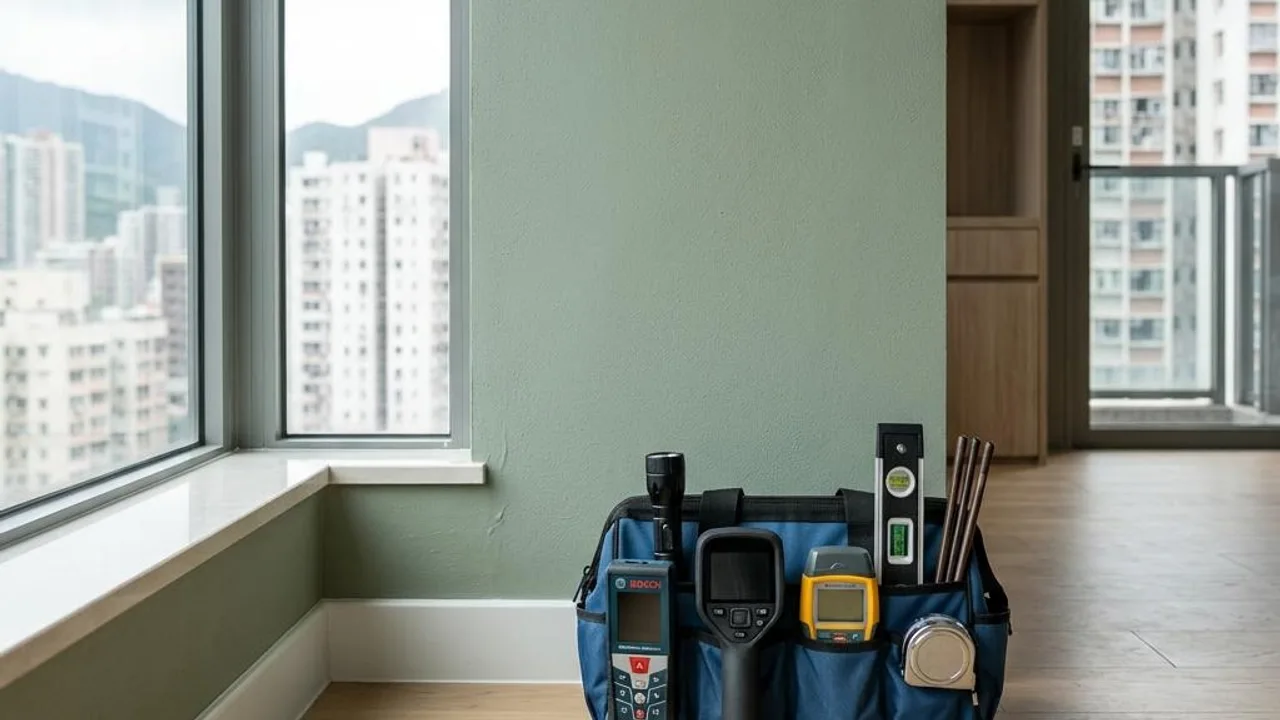
The role of property inspection tools in property checks
Property inspection is not just a casual visual experience; it requires reliance on scientific instruments for testing to discover potential hazards invisible to the naked eye, such as leaks inside structures or abnormal circuit loads. Using property inspection tools correctly can quantify property conditions, becoming core data for communication between owners and developers.
For the general owner, mastering the principles of using basic inspection tools is crucial. These tools not only help owners perform initial self-screening but are also sharp weapons for professional property inspectors during site surveys, helping to capture deviation issues such as hollow tiles, water seepage, and wall plumbness accurately, protecting the rights of residents.
- Enhance the objectivity and data-driven nature of test results
- Help quickly locate water seepage or circuit hazards
- Assist in confirming whether the renovation meets handover standards
- Ensure the indoor environment meets basic living requirements
Moisture detection and leak localisation instruments
Indoor seepage is one of the most common problems in new homes. Hygrometers are commonly used equipment by property inspectors; by measuring the moisture content of walls and floors, they can effectively determine if there are signs of water seepage. Even if no water stains are visible on the surface, the instrument can reveal hidden moisture accumulation.
In addition to hygrometers, if deep probing of wall structures is required, thermal imaging cameras can also help identify water seepage paths or locations with poor insulation through differences in temperature distribution. The use of these devices is not limited to handover; they can also be used to verify the effectiveness of subsequent repairs, ensuring that defect rectification works completely solve the problem.
- Use hygrometers to detect hidden wall moisture
- Utilise thermal cameras to observe differences in heat distribution
- Assist in judging whether the waterproofing layer has failed
- Use instruments to test window sill sealing after rain
Structural plumbness and level inspection
The flatness of walls, doors, and windows not only affects the appearance but also reflects the quality of construction. Laser levels can instantly project accurate reference lines to assist in checking the level and plumbness of walls, floors, and ceilings. If tilting or depressions are found, the deviation range can be quantified and used as the basis for requiring the developer to rectify them.
In addition, electronic angle gauges are also important tools for measuring the plumbness of door and window edges. During the renovation handover stage, ensuring that all vertical structures are at the correct angle is crucial for future furniture installation and the smooth opening/closing of doors and windows, avoiding usability issues caused by structural deviations.
- Use laser levels to check wall plumbness
- Quantify floor flatness deviation data
- Verify that door and window frame installation angles are correct
- Check if prefabricated components are installed tightly against structural walls
Electrical system testing equipment
Electrical safety is an indispensable part of home inspection. Circuit testers are used to verify if socket polarity is correct, if earthing is effective, and to test power supply stability. These instruments can quickly find connection errors within electrical circuits to prevent short circuits or electric shock risks, ensuring the safety of electrical appliance operation.
When performing electrical tests, observe the operation of circuit breakers in the fuse box to ensure that all circuits are clearly labelled and functioning normally. The testing and installation of all fixed electrical installations should follow relevant safety guidelines; if modifications are involved, they must be carried out by a registered electrical contractor and a formal completion certificate (WR1) must be issued.
- Check socket power polarity and earthing effectiveness
- Test if electrical supply circuits are stable
- Identify the accuracy of circuit labelling inside the distribution box
- Record all electrical installations that do not meet safety standards
Daily auxiliary inspection tools
Besides professional electronic instruments, high-intensity flashlights and rulers are the most basic equipment for property inspectors. High-intensity flashlights help illuminate dim corners, such as under pipes, inside cabinets, or in ceiling voids, ensuring every detail is within the scope of inspection and avoiding omissions in blind spots.
Tape measures and rangefinders are essential tools for confirming spatial dimensions and renovation compliance. By measuring reserved spaces for appliances and the standard intervals of various facilities, one can confirm whether the delivery condition provided by the developer matches the contract. While these tools are simple, they are the cornerstone of ensuring a rigorous and professional inspection process.
- High-intensity flashlights for illuminating blind spots
- Tape measures to verify space dimensions meet specifications
- Check hardware for rust or resistance when opening/closing
- Assist in confirming whether cabinet door opening space is sufficient
Common misconceptions and suggestions for property inspection
Many owners mistakenly believe that as long as they buy expensive tools, they can solve all property inspection problems themselves. In fact, data interpretation and assessment are more important than simple readings. For example, wall moisture readings will be affected by ambient humidity and climate; non-professionals may experience excessive panic due to misjudgement.
For problems found, owners should record locations in detail and take photos or videos to retain objective evidence. When suspected structural or electrical system abnormalities are found, do not attempt to dismantle them yourself; timely repair requests should be made to the developer, and qualified professionals should be hired for detailed assessment and follow-up.
- Data interpretation needs to be combined with on-site environmental factors
- Do not attempt to dismantle structures or fuse boxes yourself
- Record and photograph abnormal areas completely for reference
- Confirm the reasonableness of repair schemes through professional opinions
FAQs
Does a higher-than-standard hygrometer reading automatically mean there is a leak?
Not necessarily. Hygrometer readings are affected by ambient humidity, building material properties, and measurement location. A single value cannot be directly used as the sole evidence of water leakage. It is recommended to observe whether there are water stains, mould spots, or abnormal smells in the surrounding area, and seek a professional property inspector for further judgement.
How should one handle a situation during inspection where the circuit tester shows an earthing fault?
This is a serious safety hazard. Owners should immediately stop using that circuit socket, record the fault condition, and notify the developer or property management office. It must be entrusted to a registered electrical contractor for investigation and repair; do not attempt to unscrew the socket panel to check yourself.
When using a laser level, does a slight tilt in the wall mean the construction is substandard?
There are certain craft tolerances in building construction, but relevant deviations must be within the ranges specified by industry standards. If a noticeable tilt is found that affects the closing of doors and windows or the installation of large cabinetry, the deviation distance should be measured and recorded in detail, and the developer should be requested to conduct a defect rectification assessment in accordance with the contract and building codes.


