
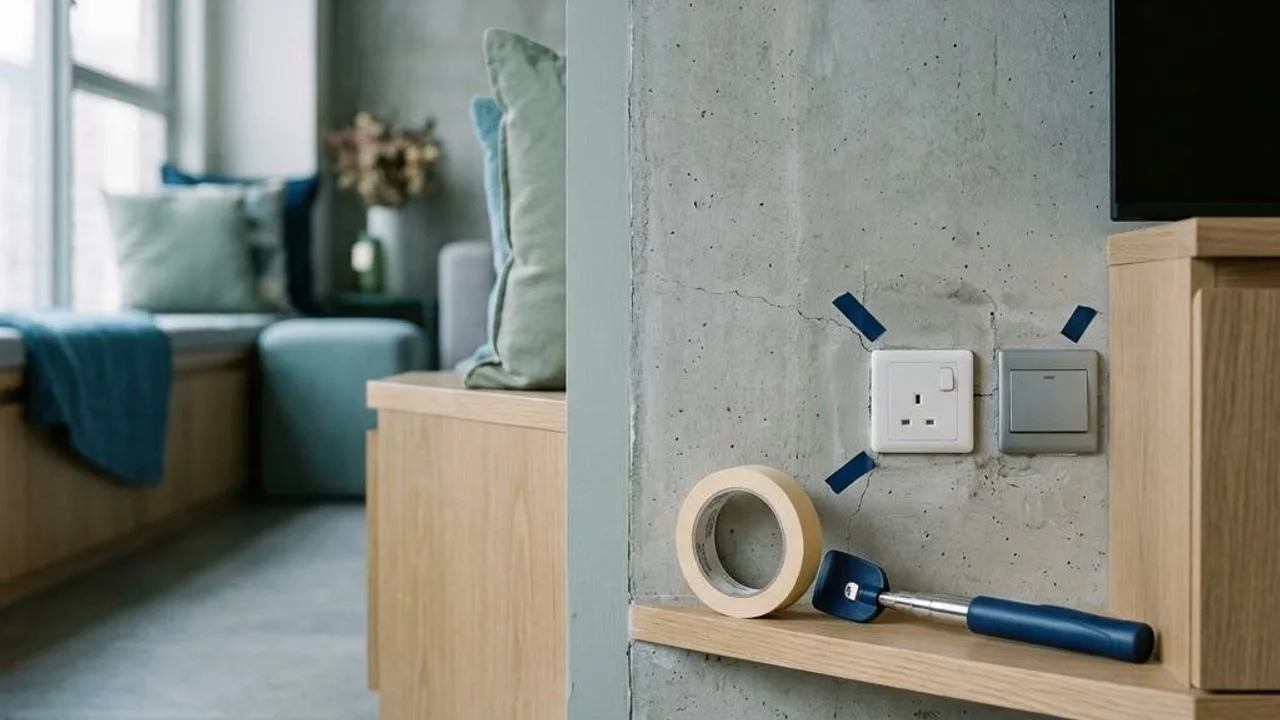
The marking function of masking tape.
When conducting preliminary inspections, masking tape is the owner’s best assistant for recording defects. When you discover uneven paint, chipped walls, floor tile scratches, or loose hardware, owners can tear off an appropriate amount of tape and stick it near that position. This marking method is eye-catching and avoids damaging the wall by writing on it directly.
Owners should take photos with their phones and record the nature of the defect on the tape simply to facilitate checking progress with the rectification team later. Clear markings not only ensure that repair work is implemented but also allow the inspector to quickly locate problems during subsequent assessments, making it time-saving and efficient.
- Choose masking tape that is easy to tear and leaves no residue.
- Use a ballpoint pen to briefly describe the defect content.
- Take comparison photos of the marked points and their surroundings.
- Remove all markings after inspection to maintain tidiness.
Telescopic rods for inspecting walls and floor tiles.
Telescopic rods or tapping sticks are common tools for identifying hollow tiles or plaster separation. Owners can gently extend the rod and slide it along the wall or tile surface while tapping, using the sound to assess the bonding condition. A crisp sound usually indicates a solid cement base, while a dull, hollow sound may indicate internal voids.
It is worth noting that this inspection method relies on the user's auditory experience. For thicker stonework or concealed structures, judgment is more difficult. This type of check is limited to a basic assessment of surface structures and cannot provide a definitive diagnosis regarding the deep layers of the wall or the waterproofing membrane.
- Tap gently to avoid damaging the finish.
- Pay attention to areas where the sound changes.
- Record suspicious locations for OPO Inspection.
- Note sound differences caused by material thickness.
The basic power-on test using a voltage tester.
Using a digital test pen or a 3-pin socket tester, owners can quickly confirm whether indoor sockets are powered. With the unit's power turned on, insert the tester in sequence to determine if each socket is properly powered based on changes in indicator lights or readings. This basic test allows owners to get a preliminary grasp of the electrical configuration.
However, this simple test is not equivalent to a professional electrical safety audit. It cannot detect reversed polarity, high earthing resistance, or the performance of the Residual Current Device (RCD) system. If it involves fixed electrical supply and modifications, one must rely on a Registered Electrical Contractor to perform the inspection in accordance with relevant regulations.
- Confirm that the tester is suitable for Hong Kong voltage.
- Test the indicator lights of each socket.
- For initial power checks only.
- Do not dismantle sockets or handle wiring yourself.
Safety precautions during the inspection process.
During on-site inspections, please ensure personal safety and do not perform any actions involving working at heights, touching exposed wires, or dismantling fixed installations yourself. These actions are not only high-risk but may also cause damage to the installation or lead to personal injury due to improper operation.
If you discover any abnormalities during the inspection, such as suspected electricity leakage, burning smells, or other obvious structural anomalies, stop immediately and record the site conditions for professional handling. Keep the site intact so that professionals can conduct a more in-depth investigation later.
- Do not climb to high places for inspection.
- Avoid touching exposed wires.
- Do not dismantle electrical switches or fixed installations yourself.
- If you smell anything strange or face a potential electric shock hazard, stop immediately.
Analysis of the limitations of tool usage.
Basic tools have their operational limits. Masking tape cannot confirm damp anomalies inside the wall, and a test pen cannot detect load balance or earthing safety in the circuit. Over-reliance on simple test results may cause one to miss concealed engineering issues, such as fine window frame seepage or water pipe conditions. This website cannot use these to prove the safety of electricity, gas, or structures, nor can it guarantee concealed locations, the thickness of waterproofing layers, or the remaining lifespan of equipment. If professional testing or statutory window inspections are required, please hire a Registered Contractor or a qualified person. Do not dismantle electrical appliances, perform electrical tests, adjust water pressure valves, or climb windows for inspection yourself.
Owners need to realise that these tools are only suitable for diagnosing surface flaws visible to the naked eye. For the property's waterproofing performance, window frame seepage tests, drainage efficiency, and the integrity of concealed pipes, one must rely on technicians equipped with professional inspection instruments.
- Surface markings do not mean the internal structure is perfect.
- Tapping tests are influenced by material density.
- Basic test pens cannot judge the performance of earth leakage protection.
- Concealed seepage requires evaluation with a professional moisture meter.
Importance of Professional Property Inspection
Although owners can conduct preliminary observations, the safety of the property's structure, waterproofing performance, and power supply system is often hidden beneath the surface of the renovation. Issues such as window frame seepage, the integrity of external wall waterproofing, and the drainage efficiency of the plumbing system require professionals equipped with instruments for accurate judgment.
A professional team can provide a systematic acceptance report, clearly identifying items in the unit that meet standards and those that require defect rectification. This not only ensures that defect rectification items are correctly executed but also effectively reduces the risk of discovering hazards after moving in, thereby enhancing residential security.
- Engage a property inspector with professional knowledge and instruments.
- Use professional analysis to distinguish between surface flaws and structural hazards.
- Ensure all engineering quality issues are correctly executed.
- Obtain a defect rectification report with reference value.
FAQs
If I find a hollow sound in the floor tiles, does it mean there is definitely a problem?
A hollow sound usually means the tiles are not fully bonded to the base; it does not necessarily represent an immediate structural danger. Owners should record the relevant locations and consult a professional to assess the stress-bearing capacity and the risk of detachment in those areas. This type of inspection reflects observation results only and is not a certification of structural safety.
If the indicator lights are normal after using a 3-pin socket tester, does it mean the electrical system is safe?
The tester can only reflect whether there is basic power and correct polarity configuration at the socket; it cannot detect the tripping time of the Residual Current Device (RCD) or the earthing resistance value. If you have concerns about electrical safety, you should engage a Registered Electrical Contractor to perform professional testing.
What tools can be used for self-inspection of seepage during a property inspection?
General owners can make a preliminary judgment by observing whether there are water stains, mould, or paint peeling on the walls. Since professional waterproofing inspection involves infrared thermal imaging or other precision instruments, it is recommended to seek professional help to obtain an accurate assessment.


