
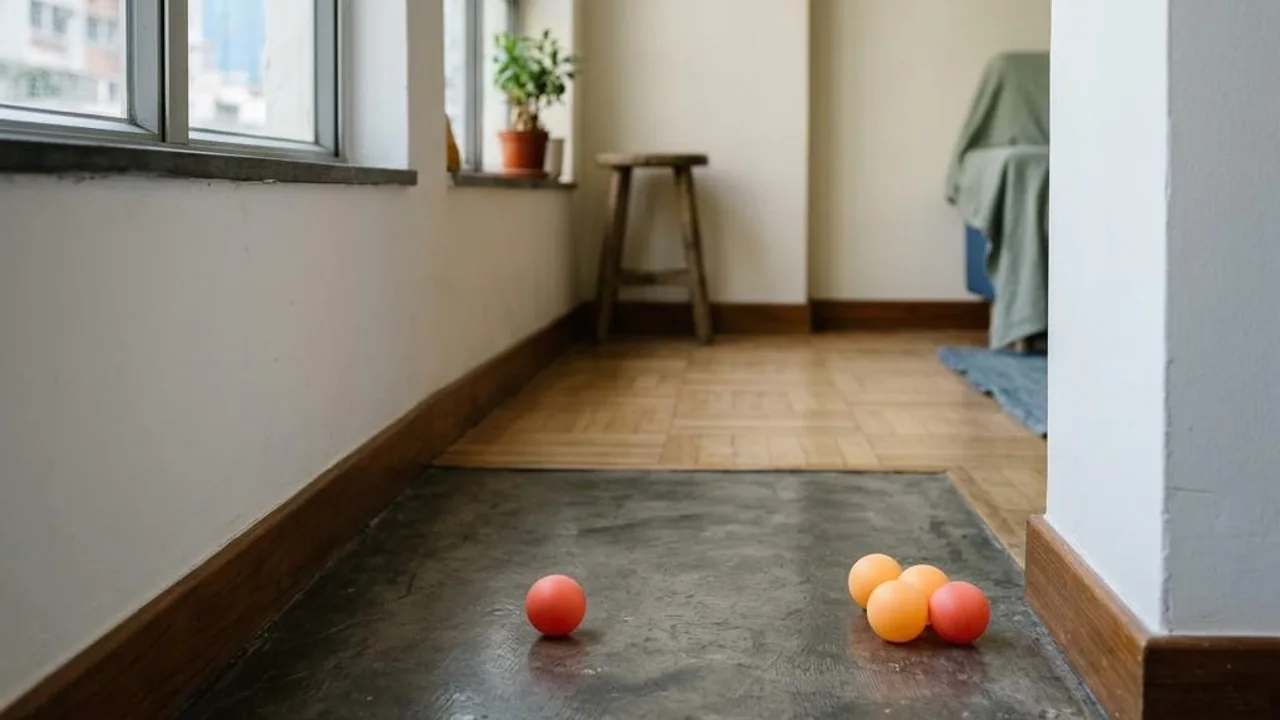
Hidden crises of floor flatness in new developments
Many Hong Kong owners, when receiving a unit, are accustomed to testing floor flatness merely by visual observation or walking while wearing shoes. However, building works involve concrete floor slab construction, formwork setting, and drying shrinkage processes. If there are deviations during the construction process, the floor surface is prone to creating height differences or micro-slopes that are difficult to detect. Visual observation is often misled by the gloss of the floor, covering up uneven conditions under tiles or wooden flooring.
If floor problems are not discovered early during property handover, the hidden risks will emerge when placing large furniture, installing embedded equipment, or laying seamless wooden flooring later. Uneven floors may cause cabinets to tilt, hollow sounds in floor tiles, or even damage to the flooring due to partial suspension. Therefore, possessing scientific inspection awareness is the first step to safeguarding your property rights.
- Concrete floor slabs are prone to deviations due to drying shrinkage during construction
- The surface gloss of tiles or wooden flooring can blur vision, covering up fine undulating patterns
- After moving in large furniture, uneven floors can cause cabinet structures to be damaged or tilted
- Uneven ground will directly affect the locking mechanisms of seamless flooring, increasing the risk of creaking noises
Physical basis and characteristics of the ping pong ball test method
Among many DIY property inspection tools, the ping pong ball, due to its smooth and lightweight physical characteristics, has become a hot topic for simple inspection items among owners. Its lightweight feature makes it extremely sensitive to micro-slopes or depressions in the ground; when placed on the ground, any faint angle will cause gravity to drive the ball to roll toward the lower point.
This dynamic feedback provides an intuitive way of preliminary observation, allowing owners to perceive floor conditions without complex equipment. For owners with limited budgets who wish to conduct basic screenings before a professional property inspection, this method is highly cost-effective and easy to carry to every room corner for testing.
- A ping pong ball is lightweight and extremely sensitive to fine slopes
- The cost of acquiring the tool is extremely low, fitting small-scale home inspection needs
- Small in size, making it easy to carry around in narrow indoor spaces
- Intuitive, dynamic feedback; no need to learn how to interpret complex data.
Standardised execution steps for ping pong ball floor inspection
Correct operation is the prerequisite for obtaining an accurate preliminary conclusion. Before testing, you must ensure the floor is thoroughly cleaned, removing all grit, stones, and dust to prevent foreign objects from blocking or altering the rolling path of the ping pong ball. After cleaning, you should perform multiple tests in key areas of the room (such as the centre of the living room, corridors, doorways, and corners) and observe the ball’s stationary state after it has been placed naturally.
It is recommended to use a cross-check method, covering the entire floor network at one-metre intervals. If the ping pong ball slides in the same direction in several adjacent positions, this indicates that the area may have a significant slope or floor subsidence. Please note that after each test, you should record the rolling direction and frequency to serve as a basic reference for future discussions with the contractor.
- Thoroughly clean the floor of debris to ensure the test path is flat and unobstructed.
- Perform stationary placement tests in key areas such as the living room, corridors, and door thresholds.
- Conduct a comprehensive inspection using a one-metre grid interval and record the rolling trends.
- Repeat the test multiple times to eliminate the influence of single-operation errors.
Comparative analysis of DIY testing and professional equipment
Owners should clearly distinguish between the levels of application for both. The DIY test method is suitable for owners to perform their own initial screening before receiving the property, while professional equipment is used for formal engineering inspections. If you wish to obtain a credible report or are dealing with complex floor slopes, a professional inspection service is the key choice for ensuring effective repairs.
When communicating with professionals, owners can provide the ping pong ball rolling observation records they have made themselves to help the OPO Inspection professional focus on specific areas. This tiered inspection model saves time and allows for targeted problem-solving.
- The ping pong ball test is a preliminary qualitative screening and cannot quantify values.
- A laser level can precisely locate deviations to the millimetre and provide a report.
- Professional data is a necessary basis for requesting defect rectification from the developer.
- Professional teams can identify local depressions and hollow tiles that are difficult for a ping pong ball to detect.
Technical limitations and blind spots of the inspection
Although the ping pong ball is easy to operate, it has significant technical blind spots. For example, when faced with tiny local pits, slight deviations in flatness, or complex material boundaries (such as the joint between tiles and wooden flooring), the rolling feedback of the ping pong ball may not reflect the full reality. Relying solely on a ping pong ball makes it difficult to capture fine problems beyond large-scale subsidence.
In addition, owners need to be aware that this type of test does not involve a structural safety inspection. Any doubts regarding floor structure or underground water pipes cannot be determined by the movement of a small ball alone; otherwise, it will mislead the direction of repairs. During the property handover process, owners should use the ping pong ball as a supplement, combined with visual observation. If anomalies are found, a professional inspector should be arranged to follow up.
- Cannot effectively capture subtle local depressions.
- Has limited reaction at junctions between different types of flooring materials.
- Cannot detect structural problems or concealed piping within the floor structure.
- The result of a single test cannot be directly regarded as an absolute building quality standard.
FAQs
If the ping pong ball rolls during the test, does it mean the floor necessarily has a serious quality issue?
Not necessarily. The rolling of the ping pong ball only reflects that there is a slope at that point; the specific severity depends on the magnitude of the deviation. Owners should record the observed rolling direction and invite a professional to use a laser level for a quantitative inspection to confirm whether it exceeds the reasonable tolerance range for flatness.
Can I check the floor myself after handover?
Yes. But during the self-inspection, you must ensure the floor is clean. If your self-test reveals large-scale, consistent, unidirectional rolling of the ping pong ball, you should record a short video and include this phenomenon in the defect rectification list to be checked by a professional inspector or the developer’s representative.
If the ping pong ball rolls indoors, what should I do?
First, please rule out indoor airflow or other external force influences. If there is a clear rolling pattern in multiple positions after repeated tests, please do not attempt to dismantle the flooring yourself. You should consult a qualified property inspector to request a comprehensive flatness assessment and submit a formal repair request to the contractor based on a professional report.


