
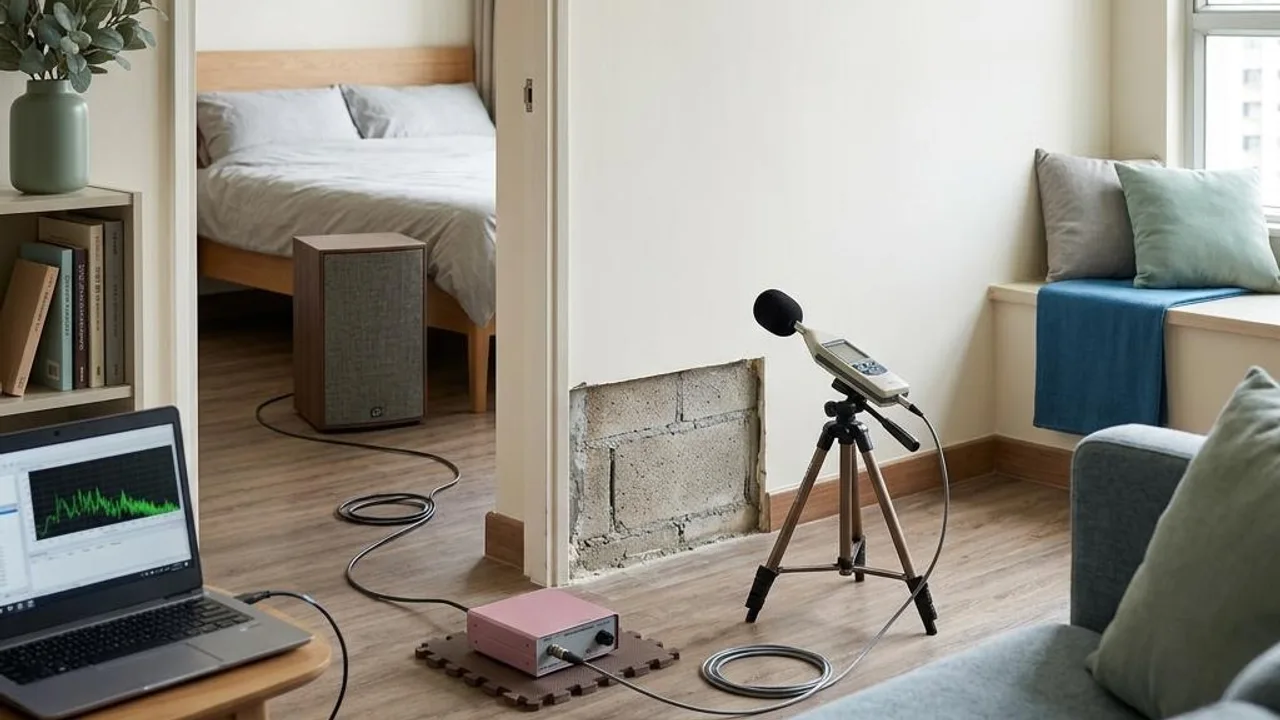
The importance of acoustic environment testing
A good residential acoustic environment is crucial for personal rest and quality of life. During property inspection, owners often focus on renovation flaws while neglecting environmental noise and structural sound transmission issues—factors that are difficult to resolve after moving in.
A professional property inspection process should appropriately evaluate the noise levels and sound insulation conditions within a unit. Through environmental noise measurement and structural vibration analysis, potential noise disturbance sources can be discovered early, allowing owners to raise appropriate concerns during the handover stage.
- Assess the impact of environmental noise on indoor space
- Identify anomalies in the sound insulation performance of walls and floor slabs
- Check for structural resonance interference with living comfort
- Provide a digitised reference for acoustic environment assessment
Environmental noise level measurement
Environmental noise measurement is the foundational step of acoustic assessment, typically using professional decibel meters to take samples at different times. By observing noise changes between day and night, one can fully understand the level of disturbance from the surrounding environment to daily living.
During testing, the inspection personnel will record the indoor background noise level. Although regulations do not set an absolute decibel cap for private residences, excessive continuous noise significantly affects quality of life. Test results help owners decide whether to install soundproof windows or implement noise-reduction measures.
- Record indoor decibel values at different times of the day
- Assess noise sources generated by external traffic or facilities
- Observe the role of window sealing in noise protection
- Compare with reference data to analyse the quality of the living environment
Structural sound insulation performance analysis
Sound propagation testing primarily examines the sound insulation performance of building materials and structures. By emitting a sound source at a specific frequency on one side of a space and measuring the degree of sound attenuation on the other, one can make a preliminary determination of the sound-blocking effect of a wall or floor slab.
A good sound insulation design should effectively weaken sound interference from neighbours or corridors. If testing shows that the sound insulation effect is far below expectations, it may involve issues with construction density or material specifications of the building partition, requiring professional assessment of its impact on future living.
- Assess the sound transmission suppression power of wall structures
- Test for sound penetration at door gaps and joints
- Check the construction integrity of sound insulation materials
- Analyse acoustic isolation indicators between different spaces
Structural resonance and vibration testing
Resonance problems are usually caused by the characteristics of the building structure, leading to intensified vibration at specific frequencies and producing an uncomfortable resonant sensation. Professional testing will check the frequency response of floor slabs under external vibration sources to identify whether there are structural defects.
In modern building inspections, using precision instruments to measure vibration frequency is an effective means of identifying potential structural resonance. If abnormal resonance phenomena are discovered within a unit, owners should record details and consult professionals to assess whether it will affect the sense of security in daily living.
- Detect the vibration response of the structure at specific frequencies
- Identify structural locations that may cause resonance
- Use professional equipment to analyse abnormal vibration data
- Assess the impact of structural vibration on resident comfort
Indoor acoustic reverberation performance
Sound reverberation time reflects the acoustic reflection characteristics within a room. During the emptier property inspection stages, the reverberation effect is more pronounced due to the lack of sound-absorbing decor. Measuring reverberation time helps in understanding the acoustic structural configuration of the interior space.
Excessively long reverberation times can cause sound clutter indoors, leading to discomfort during conversation or leisure. Through professional testing, owners can understand the unit's acoustic potential and select suitable sound-absorbing finishes during future renovation to create a more tranquil home environment.
- Measure sound reverberation time in vacant spaces
- Assess the effect of wall materials on sound reflection
- Examine the role of interior spatial structure in sound diffusion
- Provide recommendations for adjusting interior acoustics during renovation
Professional acoustic testing recommendations
Acoustic testing involves professional equipment and data analysis; it is recommended that owners hire an experienced professional property inspection team to perform it. A professional team can not only provide accurate test data but also offer practical improvement directions based on the results, preventing owners from blindly investing in renovation costs.
Owners can request the property inspector to provide a professional analysis report on high-frequency and low-frequency noise. If abnormalities are discovered, relevant technical professionals should be engaged to evaluate treatment plans based on the data, ensuring the indoor environment meets ideal living standards.
- Use professional measuring instruments to ensure data accuracy
- Comprehensive environmental and structural analysis conducted by technicians
- Provide objective improvement recommendations based on test data
- Assist owners in determining whether the property meets expected standards
FAQs
How should poor sound insulation discovered during property inspection be handled?
Owners should record the affected locations and the nature of the sound. It is recommended to ask professional property inspectors to provide test data and consult with renovation designers to assess whether it is necessary to install sound-insulating layers or use specific finishing materials during renovation to improve the situation.
Who should be consulted if there is an abnormal vibration sensation indoors?
If obvious resonance or abnormal vibration occurs indoors, it is recommended that owners record the time and frequency of the vibrations in detail and contact professionals qualified in structural inspection to carry out an on-site survey and analysis.
Why is it necessary to measure reverberation time when inspecting a new property?
Measuring reverberation time helps to understand the acoustic reflection characteristics of the indoor space. If the reverberation is too long, it may affect the comfort of the indoor environment after moving in. Owners can make appropriate adjustments during the design phase based on the data.


