
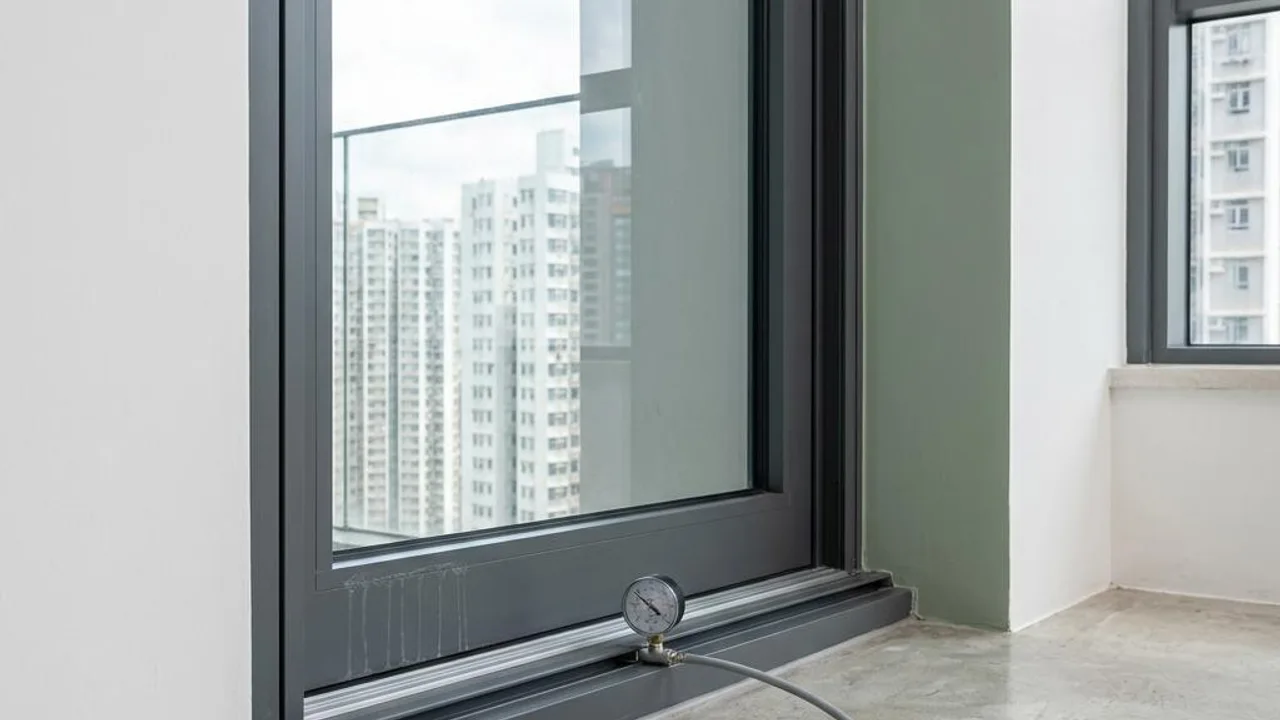
Why is it necessary to check window sill airtightness?
Hong Kong is frequently affected by typhoons and rainstorms in summer and autumn. As the first line of defence for residences against external wind and rain, the performance of window sills and window curtain walls directly affects the stability of the indoor environment. Over time and with prolonged sun exposure, the waterproof rubber seals around the window frames and the sealing materials at the exterior wall joints will naturally age, losing elasticity or developing fine cracks invisible to the naked eye.
If these sealing issues are not discovered early, under the strong wind pressure of a typhoon, rainwater is easily forced into the wall, leading to indoor wall blistering, mould, or damage to wooden flooring. Through a professional airtightness inspection, structural integrity can be confirmed before the typhoon season arrives, ensuring that windows can effectively block wind and rain, avoiding additional repair costs caused by water seepage.
- Confirm whether window frame rubber seals have hardened or peeled off
- Check if there are cracks on the exterior wall window frame edges
- Test the tightness of window lock positions
- Prevent indoor water seepage phenomena caused by insufficient airtightness
Assess the structural safety of windows
Apart from waterproof performance, the structural safety of windows is equally critical. The wind pressure endured by high-rise buildings during typhoons is tremendous, placing strict demands on the sturdiness of window frame hinges, screw fixing points, and glass panels. During the inspection process, focus on assessing whether window sashes are deformed and whether all metal fittings show signs of severe oxidation, loosening, or loss of support function.
Ensuring that windows possess sufficient pressure-bearing capacity when closed is core to safeguarding home safety. If hinge loosening or corrosion of fixing points is discovered, it should be treated as a warning sign, and a qualified person should be arranged to follow up immediately. Please note that visual inspection can only observe surface conditions and cannot replace a mechanical assessment of the installation structure by a professional engineer.
- Inspect hinges and metal fasteners for corrosion
- Check if there is swaying when the window sash is locked
- Observe whether there is obvious loosening at the glass edges
- Assess whether the window frame structure has distorted due to stress
Preventive maintenance strategy before typhoon season
Integrating inspections into daily property maintenance is a forward-looking management attitude. Arranging a comprehensive safety review before a storm arrives allows owners to master the initiative for repairs. Replacing ageing accessories or re-filling with highly weather-resistant waterproof sealant—these preventive measures are far more effective than emergency repairs during a typhoon and can significantly reduce wear and tear on building materials from wind and rain.
Regular maintenance plans not only prevent issues before they happen but also effectively extend the service life of windows and related building materials. For owners, this is a responsible attitude towards their assets, ensuring that the residence maintains good living conditions and internal facility quality after being subjected to multiple bouts of severe weather.
- Replace ageing waterproof seals that have lost elasticity
- Repair fine cracks on the edges of exterior window frames
- Regularly clean window frame hinges and add lubricant
- Plan window maintenance in advance to avoid the typhoon season peak
The role of professional property inspection teams
Window sill safety inspection involves complex building physics and structural assessment; it is difficult for non-professionals to accurately judge the wear of concealed areas by visual observation alone. Professional property inspection teams in the market use infrared thermal imaging analysis and airtightness testing instruments, enabling a scientific assessment of window frame sealing performance without damaging wall structures, providing data support for owners.
Inspection by professionals can assist owners in identifying the unit's condition and confirming whether maintenance is required. If the building is 10 years or older, it is recommended to hire a qualified person under the Mandatory Window Inspection Scheme for a statutory inspection. Professional assessment aims to clarify wear and potential risks but does not guarantee complete structural compliance or the condition of the waterproof layer. If window frame structure or statutory requirements are involved, consult a registered contractor or relevant professionals, and never dismantle windows or perform high-risk repairs yourself.
- Use infrared instruments to assist in checking leakage risks
- Provide objective data on window frame airtightness performance
- This guide aims to assist owners in determining whether a statutory mandatory window inspection needs to be arranged. Please note that this type of inspection cannot confirm building structure, electricity, gas safety, concealed pipe conditions, or the thickness of the waterproof layer, nor can it predict remaining service life or repair effectiveness. Thermal imaging technology only shows surface temperature distribution and cannot be taken as direct evidence of the cause of water seepage or concealed structural problems. Please do not view inspection tools as a guarantee that all hidden defects will be revealed. Mandatory window inspection is an independent statutory procedure, applicable only to buildings that have received a statutory notice from the Buildings Department, and must be executed by a registered inspector of the Buildings Department; it is not a routine service provided on this website. For professional technical issues, please refer to relevant professionals. Never perform electrical testing, dismantle fixed installations, adjust water pressure valves, or climb roofs or exterior wall windows yourself. Inspection results should be viewed as observation records and should not be treated as absolute proof of safety.
- Provide a risk assessment report that meets owner concerns
Daily window sill observation guidelines
As a homeowner, daily observation is the first step in preventing window sill problems. Every time you clean the windows, besides wiping away surface dirt, you should also look out for tiny cracks in the window frame joints and check if there are any signs of water accumulation at the bottom of the window sill after it rains. These visible signs are often early warning signals that the sealant has aged or the waterproofing has failed.
If you notice that the window does not operate smoothly when opening or closing, or if the lock cannot engage tightly, do not force it. In such cases, you should carefully document the location and nature of the damage and provide this information to a registered contractor for assessment. Remember, any structural inspection or adjustment must be carried out by a qualified professional; do not attempt to dismantle or force-replace structural components yourself.
- Observe if there are water stains around the window sill after rain.
- Take note of any unusual noise or resistance when opening or closing windows.
- Document any cracks or peeling at the window frame joints.
- Check if there is blistering paint on the wall near the window.
FAQs
How can a homeowner determine if water seepage at the window sill is caused by insufficient airtightness?
Homeowners can observe whether water stains are seeping into the area around the window sill after rain. If you find that the sealing strips are clearly cracked, hardened, or peeling away from the window frame, this situation usually affects airtightness, causing rainwater to enter with wind pressure. It is recommended to check if the seepage location corresponds to the damaged points of the seal and to seek a professional inspection.
If I find that the window hinges are rusted or deformed, can I buy parts and replace them myself?
No. Window structural components involve the safety of the building's exterior walls; any structural replacement or repair must be carried out by a qualified registered contractor. Attempting to replace them yourself may lead to the window not being properly secured, posing a serious safety risk, and repairs without professional assessment may fail to meet relevant building regulation requirements.
What is the difference between the Mandatory Window Inspection Scheme and daily airtightness checks?
The Mandatory Window Inspection Scheme is a statutory mandatory inspection regulated by the government, aimed at ensuring window structural safety and preventing falling risks. As for window airtightness checks, these fall under preventive maintenance for homeowners, focusing on the window's waterproofing performance and indoor comfort. Both are different in nature but equally important; if any structural abnormalities or potential safety issues are found during daily checks, you should immediately consult a Buildings Department registered contractor for a professional inspection or repair, and never dismantle or force repairs yourself.


