
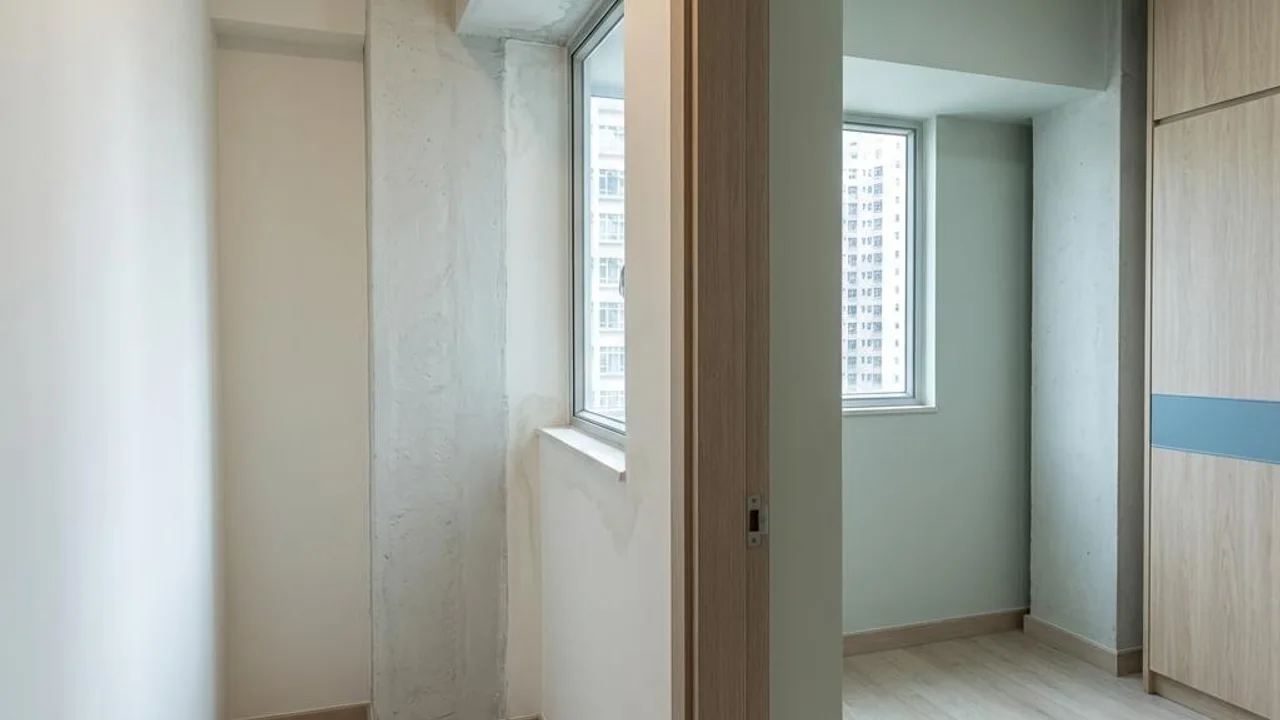
Inspection of open-plan kitchen connection points.
Small units often have open-plan kitchens, and the boundary between them and the living room is a key inspection area. Due to differences in material properties, changes in temperature and humidity easily cause cracks in wall or floor tile joints.
Be sure to carefully check the junction between the countertop and the floor, confirm whether the silicone sealant is fully closed, and verify if the ceiling smoke detector and automatic sprinkler system positions are correct.
- Check for cracks in the joints of stone countertops and floor tiles.
- Confirm whether glass sealant strips are falling off.
- Check the junction between the kitchen area and the living room floor.
- Check if ceiling fire protection device configurations are complete.
Testing bathroom shower stall and hidden pipes.
Bathroom space is limited; insufficient slope in the shower stall easily causes water accumulation or backflow. Owners can conduct a water splashing test to observe if water flows smoothly to the drain and check if the floor tile installation is level.
Drainage pipes hidden under compact cabinet units require closer attention. Use a high-intensity torch to inspect the pipe connections at the bottom of the basin to confirm there are no signs of leakage, preventing moisture accumulation from causing mould within the cabinets.
- Perform a simple water pouring test to observe the drainage speed.
- Check the gradient (slope for water drainage) of the shower floor tiles.
- Use a high-intensity torch to inspect concealed pipe connections under the basin.
- Monitor drainage pipes for any signs of micro-dripping.
Floor-to-ceiling glass doors and windproof airtightness.
Many luxury units feature large floor-to-ceiling windows to enhance the sense of space; the airtightness of their window frames directly affects sound insulation and wind protection. Repeatedly open and close sliding doors to test the tracks for any abnormal noise or resistance.
Observe whether the seals on the edges of the window frames sit flush against the frame and if there are any signs of ageing or brittleness. The stability of window hardware in high-rise units is particularly critical; confirm that locking mechanisms operate smoothly and are not loose.
- Test whether the sliding process of window doors is smooth and stable.
- Confirm whether there are any gaps caused by ageing in the window frame rubber seals.
- Check the stability of window locks and hinges.
- Listen for any abnormal friction noises during the opening and closing process.
High-level storage cabinets and installation stability.
Units often feature wall-mounted or high-level storage cabinets. In addition to testing whether cabinet doors open and close smoothly, owners must inspect whether the cabinet body is securely connected to the wall and check for any noticeable gaps.
Gently push the cabinet to assess the strength of the installation. If gaps are visible before the cabinet is loaded, the risk of structural displacement will increase significantly once it is weighed down by items in the future; these should be identified early and defect rectification should be requested.
- Check the flatness of the connection between the wall-mounted cabinet and the wall.
- Test whether cabinet doors open and close smoothly without sticking.
- Gently push the cabinet body to assess the stability of the connection.
- Observe whether there is any deformation caused by water leakage at the installation position.
Electrical circuit distribution and socket safety check.
The power and low-voltage electrical layout in compact spaces is precise, with socket positions mostly arranged around preset furniture locations. Owners should test every socket one by one to ensure the power supply is functioning correctly.
Pay special attention to sockets near water sources (such as kitchen sinks or bathroom basins); they must be equipped with waterproof splash-proof covers, and the installation position must be verified to maintain a safe distance from the water source.
- Test each socket one by one to ensure the power supply is functioning normally.
- Check whether kitchen and bathroom sockets have waterproof face covers.
- Check whether the socket positions are suitable for the user's electrical appliance habits.
- Monitor whether there are any obvious hidden dangers regarding exposed electrical wiring.
The necessity of professional property inspection.
Although owners can identify surface issues in a unit through visual inspection, the complex concealed works in luxury units (such as waterproofing performance and the state of concealed pipes) involve structural and system safety, which cannot be covered by general visual inspection. Such inspections cannot guarantee internal structural integrity, the safety of electrical or gas systems, legal compliance, or predict the remaining lifespan of equipment. If specific Building Ordinance requirements (such as the Mandatory Window Inspection Scheme) are involved, they must be handled by qualified persons registered with the Buildings Department, rather than falling under the scope of a general inspection.
For hidden dangers or structural safety issues involving professional engineering, a registered professional should be consulted; do not attempt to dismantle electrical components, handle water pressure valves, or enter high-risk areas yourself.
It is recommended to contact a qualified property inspection expert to conduct tests on hidden wall seepage or the integrity of waterproofing layers that you cannot evaluate yourself, in order to obtain assessment recommendations of reference value.
- Utilise professional equipment to inspect concealed water and electrical pipes.
- Assess the integrity of the waterproofing layer and the structural condition.
- Provide a detailed report for comparison during future defect rectification.
- Professional experience covering various types of luxury fit-out units.
FAQs
When inspecting a bathroom, how can an owner determine if the drainage is acceptable?
Owners can carry out simple observations to ensure there are no obstructions around the drain, and perform a water-pouring test to observe whether the water drains away completely within a short time and if there is any ponding in the shower area. If the drainage is extremely slow or if there is backflow, you should record the phenomenon and consult a property inspection expert.
If ageing of the window frame rubber seals is discovered, is it necessary to replace them immediately?
Ageing of rubber seals will affect airtightness, and in the long run, it may lead to reduced wind and waterproofing performance. If an owner discovers hardening or cracks in the rubber seals, it should be recorded when taking possession of the property and the relevant person in charge should be notified to handle it, so as to avoid potential seepage issues on rainy days.
Regarding concealed water and electrical engineering, how should an owner appoint a qualified person to inspect it?
For issues beyond the scope of visual observation, such as the condition of internal wall pipes, owners can appoint persons holding professional licenses or relevant technical qualifications to use professional testing equipment to conduct a detailed investigation and request objective written data regarding the test results.


