
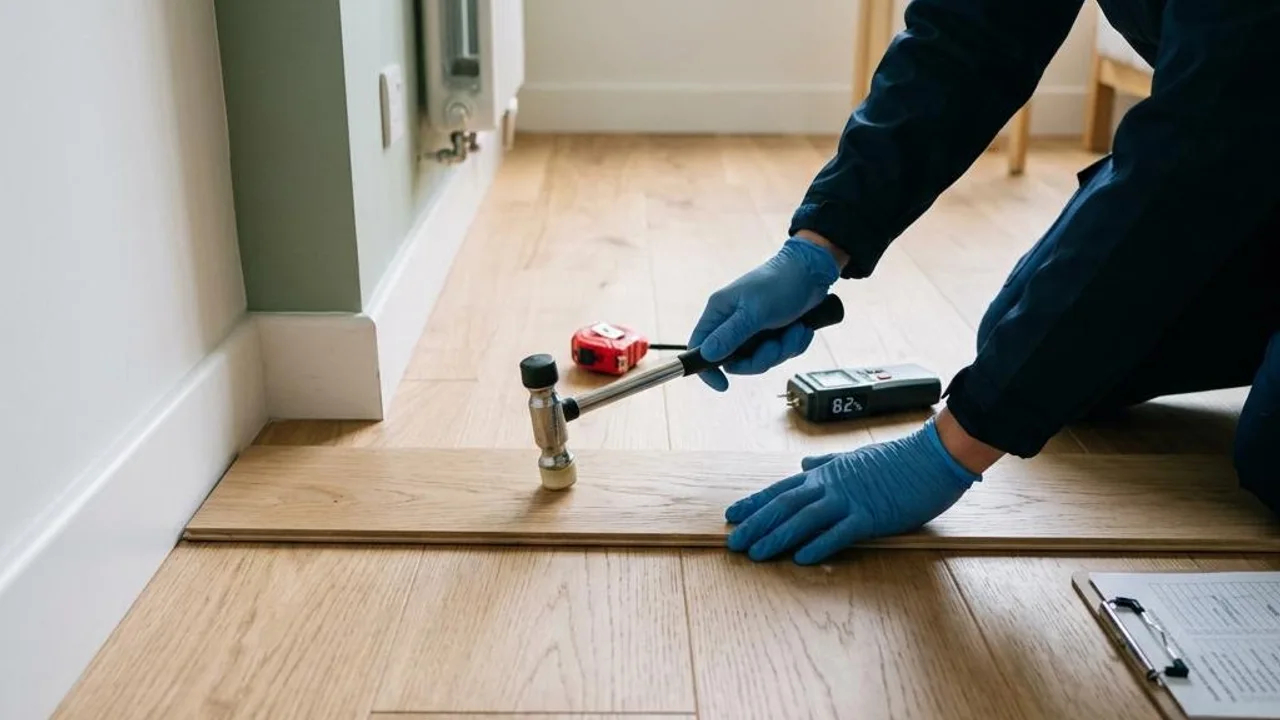
Material quality and environmental standard inspection
The primary focus for timber flooring inspection is material consistency. Owners must verify that the timber species, grain and colour of the actual installation match the renovation contract terms, and inspect the surface for visible defects such as edge chipping, significant colour variation, insect damage or deep scratches.
Environmental indicators must not be ignored. Owners have the right to request the renovation contractor provide a test report for the timber flooring, specifically verifying that the formaldehyde emission levels meet relevant safety standards to ensure indoor air quality is not compromised at the source by flooring materials.
- Verify consistency of timber species and grade against the contract
- Check surface workmanship such as coating flatness and pinhole issues
- Ensure environmental test certificates are valid and compliant
- Compare the degree of matching between samples and the actual grain
Packaging identification and specification verification
Before or during partial unpacking, packaging integrity should be inspected. High-quality timber flooring should have clear product identification, including manufacturer name, specific model, production batch number and execution standards, which can effectively prevent the substitution of inferior goods.
Specification precision determines the visual effect after laying. Some samples should be taken to measure the tongue and groove dimensions to ensure tight interlocking during assembly, avoiding obvious height differences or excessive gaps after installation due to significant dimensional errors.
- Confirm the packaging crates are intact with no signs of water seepage
- Verify that production labels match the order details
- Check the uniformity of the plank length and width specifications
Laying workmanship and moisture/crack prevention details
The levelness after installation is the core of the inspection; a spirit level should be used to check if the entire room's flooring is uniform, with no obvious depressions or springy floating. The preparation of the base floor is directly related to the stability of the flooring; residual cement blocks or unevenness from the past should be dealt with before laying.
Edge sealing directly affects future usage experience. It is generally recommended that the width of the expansion joint at the wall be controlled at approximately 5 to 10 millimetres to handle the natural physical characteristics of timber expanding with heat and contracting with cold. Additionally, the installation of the moisture barrier should remain intact with tight seams to assist in blocking the potential impact of underground dampness on the flooring structure. Such inspections are limited to surface observation and cannot guarantee the construction quality of hidden layers or the long-term control effect of underground dampness.
- Check for any unusual noise or looseness when walking on the floor
- Verify the clearance specifications of the wall expansion joints and skirting boards
- Confirm whether the moisture barrier installation meets full coverage requirements
- Check whether the joints are tight and free from misalignment
Surface appearance and inspection standards
During the final stage of inspection, focus on the surface integrity after installation. Scratches, stains or damaged paintwork caused during construction must be rectified or replaced before handover. For minor defects, professional wood repair agents can be used.
Check the uniformity of the paint colour to ensure that there are no obvious jarring colour differences in the flooring from different batches or areas under light. At the same time, confirm whether the transition between the skirting board and the wall is smooth, and whether there are any glue traces or excessive construction gaps.
- Ensure the surface is free from obvious construction scratches and stains
- Verify the uniformity of paint colour
- Confirm that the colour of repaired areas coordinates with the surroundings
- Check for excessive indentations at furniture contact points
Daily maintenance and usage advice
After handover, owners should adopt correct cleaning methods, avoid using overly wet mops, and keep indoor humidity within a reasonable range. Regular maintenance can effectively extend the service life of the timber flooring and ensure the quality of the long-term living environment.
During daily use, if you find unexplained bulging or unusual noise in a specific area, observe the surrounding environment for moisture sources and consult a professional for assessment. Do not disassemble the flooring yourself to avoid damaging the overall laying structure.
- Keep indoor humidity stable to reduce timber deformation
- Avoid using overly wet mops and harsh chemical cleaners
- Install protective pads on the bottom of furniture legs to prevent wear
- Regularly observe the flooring joints for abnormal changes
FAQs
If colour differences are found on the floor surface during inspection, is it considered a construction defect?
Some timber naturally has colour variation, but if the colour difference is severe or vastly different from the sample, it is recommended to verify the order specifications and, after recording it, ask a professional to confirm whether it is a material grade issue.
If there is unusual noise when walking on the floor, how should it be handled?
Unusual noise is usually caused by uneven ground or insufficient expansion joints leading to pressure collision. Owners can record the area with the noise and consult the installer; do not attempt to disassemble the floor for inspection yourself.
Does a minor scratch on the timber floor surface require replacing the entire floor plank?
Depending on the depth of the scratch, minor surface scratches can be improved through wood repair agents. If the scratch involves structural damage, you should consult a professional craftsman to assess whether partial replacement is required to maintain the seal and aesthetics of the flooring.


