
Water Hazard Troubleshooting: Drainage and Leakage Tests
Water leakage is the most serious hidden danger in a new home. When inspecting a bare-shell unit, you must conduct extreme tests, especially for the floors in the kitchen, bathroom, and balcony. It is essential to ensure drainage is smooth, and there must be no backflow or 'puddles' formed by stagnant water. If you discover that the drainage speed is too slow or that water cannot be drained away, it must be recorded immediately, and the contractor must be requested to adjust the floor gradient.
Simultaneously, all water taps in the unit should be turned to the maximum for several minutes to observe the sealing conditions of all connection points. Homeowners can touch the U-trap under the washbasin and hidden water pipes to confirm if there are any subtle leaks or drips. Toilets must also be flushed three times consecutively, and the base area should be wiped with a paper towel to ensure the connection point is completely dry without signs of water leakage.
- Check if floor drainage is smooth and free of standing water.
- Drain water thoroughly and touch all drainage pipe connection points.
- Flush the toilet multiple times consecutively to check the seal at the base.
- Confirm that all washbasins and kitchen sinks are free of leaks and drips.
Walls and Floor Tiles: Hollow and Levelness Checks
Whether it is a luxury renovation or a standard finish, surface defects are common on walls and floors. Use a professional inspection rod or a coin to tap along the walls and floor tiles. If a crisp, hollow 'clack' sound is heard, it indicates hollow spots inside, meaning the mortar base layer is not fully filled, and the tiles will be highly likely to crack or loosen later. All detected hollow points must be clearly marked for re-laying.
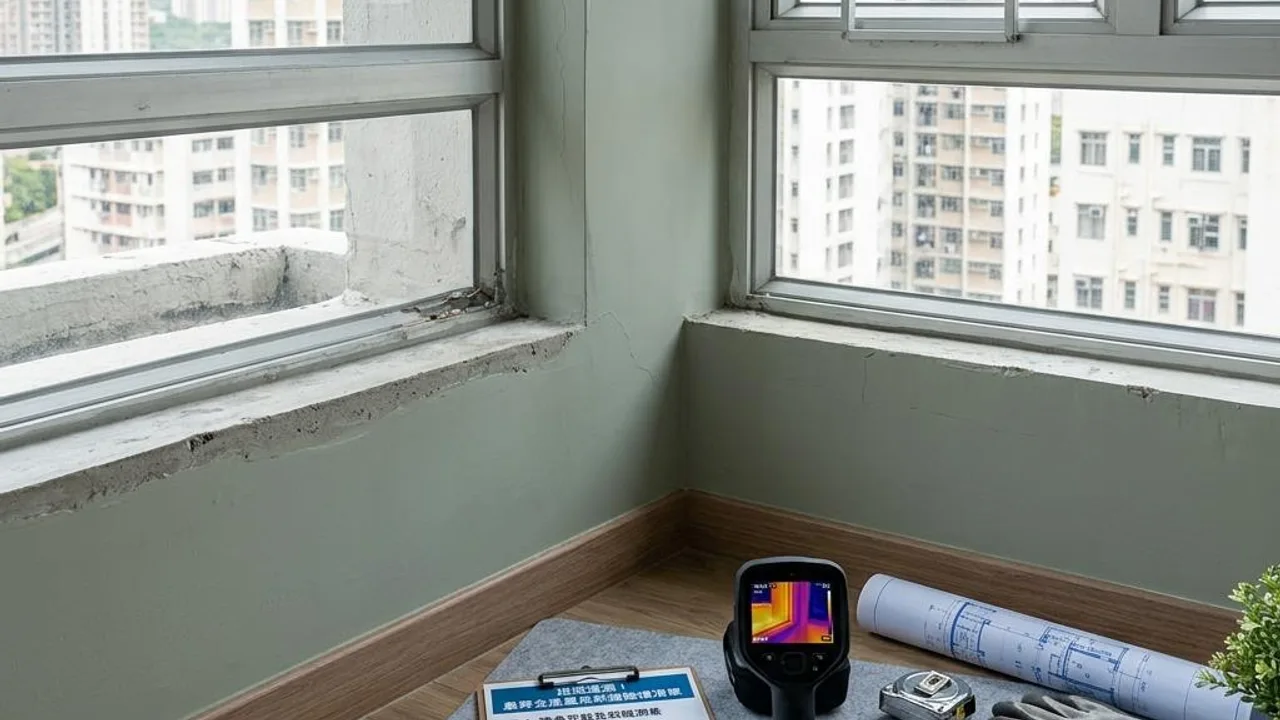
When checking wall smoothness, it is recommended to do so at night or with dimmed indoor lights, using a high-intensity flashlight shone at an angle parallel to the wall. This effectively reveals wavy patterns or paint runs caused by uneven wall plastering. Additionally, carefully observe if there are scratches on the glass, and verify that the silicone sealant at the edges of window frames is even and continuous to ensure there are no gaps that could lead to water seepage.
- Use an inspection rod to tap tiles and walls throughout the unit to identify hollow spots.
- Use lateral light to check wall smoothness and paint craftsmanship.
- Check if the window frame sealant is continuous and free of breaks.
- Carefully read the glass surface for any scratches or damage.
Hardware, Switches, and Electrical Safety Inspection
The hardware for all doors, windows, and cabinets in the unit directly affects future quality of life. It is recommended to open and close main doors, room doors, aluminum windows, and cabinet doors at least ten times, observing whether door hinges make abnormal noises, whether locks operate smoothly, and if there are significant gaps causing drafts after closing. Any components that do not open or close smoothly must be adjusted to a flexible state.
Electrical inspection must ensure that all power sockets function normally. Homeowners can use appliances or a test pen to check the power supply of each socket one by one. Furthermore, it is essential to open the main distribution board to check if labels are clear and to press the 'RCD' (Residual Current Device) to test whether the leakage protection function is working correctly. Remember, if any modifications involve the interior of the distribution board or fixed installations without sockets, you must hire a 'Registered Electrical Contractor' to handle it.
- Repeatedly test the opening and closing flexibility of all doors, windows, and cabinets.
- Confirm the power status of power sockets throughout the unit one by one.
- Test if the RCD function in the distribution board is effective.
- Confirm that all electrical labels are clear and meet safety standards.
Professional Property Inspection: Protecting Property Rights and Follow-up
Although homeowners can carry out initial observations, property inspection involves professional engineering knowledge and precision equipment. For hidden dangers difficult for the naked eye to detect—such as water seepage from micro-cracks in external walls, the condition of in-wall pipes, or ceiling structure risks—relying solely on experience may not be accurate. Finding a professional OPO Inspection team can provide more comprehensive safety guarantees and protect homeowners' rights through precise engineering data.
A professional team will use infrared thermal imaging cameras and high-definition instruments to assist in the inspection and compile inspection records with reference value, providing homeowners with strong justifications for defect rectification. Through a professional report, homeowners can communicate more effectively with developers or contractors to implement necessary repairs, ensuring home safety and quality.
- Use an infrared thermal imaging camera to detect hidden dangers in the walls.
- Obtain inspection content supported by professional engineering evidence.
- Ensure rights are protected and follow up on defect rectification progress effectively.
- Identify structural defects invisible to the naked eye through a professional perspective.
Key Considerations for Property Inspection
On the day of the property inspection, the primary task is to ensure that the water and power supply systems in the unit are fully connected; otherwise, it will be impossible to test socket power status or pipe leakage. If the homeowner plans to perform special tests, such as a high-pressure water jet test, they must apply to the management office in advance to avoid affecting neighbors.
During detection, all observed conditions should be recorded in detail. Such general home inspection records are only for visible areas and cannot verify structure, electricity, gas safety, compliance, hidden pipe conditions, or waterproofing thickness. They cannot assess remaining service life or repair effectiveness. Infrared thermography only shows surface temperature distribution and cannot be considered proof of the cause of water leakage or hidden structural issues; detection tools do not guarantee that all hidden defects will be found. The Mandatory Window Inspection Scheme is a separate procedure that must be executed by a Qualified Person registered with the Buildings Department and is not part of routine inspection.
If professional technical issues are encountered, they should be referred to qualified persons for processing; do not suggest being able to prove all safety conditions. Do not attempt to dismantle electrical installations yourself, adjust water pressure valves, climb on roofs, or work outside windows. Please keep observation records and refer to professional advice, avoiding making unsubstantiated absolute promises.
- On the day of the inspection, ensure that electricity and water supply systems are connected.
- If there are special requirements such as a high-pressure water jet test, apply in advance.
- Ensure all findings during the inspection have video and written records.
FAQs
If hollow spots are discovered on the wall during property inspection, is it mandatory to require re-laying?
Yes. Hollow spots indicate that the tiles or plaster are not firmly bonded to the wall. The risk of tiles loosening, falling, or cracking in the future is high, so they should be clearly marked during the inspection stage and the contractor should be required to perform repairs or re-laying.
During a self-inspection, how should the safety of the distribution board be tested?
Homeowners can mainly check if the distribution board labels are clear and press the 'RCD' (Residual Current Device) inside the board to test if the power-off function is normal. If the RCD fails to trip or if there are technical issues involving the interior of the board, it should be handled by a Registered Electrical Contractor; do not attempt to dismantle it yourself.
Why do professional property inspections require the use of an infrared thermal imaging camera?
An infrared thermal imaging camera can detect temperature changes invisible to the naked eye, helping to find water seepage inside walls, pipe leaks, or hidden structural problems, providing more scientific engineering justifications than naked-eye observation, which makes it easier for homeowners to follow up on repairs.


