
The importance of window airtightness to the living environment
The airtightness performance of windows directly affects the energy-saving efficiency, sound insulation level, and overall comfort of the indoor environment. Good airtightness means that the seal between the window frame and the glass, as well as the connection between the window frame and the wall, is effective at preventing cold air infiltration or air conditioning leakage. This plays a key role in controlling indoor temperature and humidity and improving air conditioning operating efficiency.
When window airtightness is poor, it often leads to air conditioning loss, significantly increasing energy consumption. Furthermore, insufficient airtightness can become a channel for moisture to enter the interior; long-term dampness can easily lead to mould growth on walls and even cause the window frame materials to rust or deteriorate. Therefore, property owners should prioritize regular inspection of window seals.
- Reducing external noise from entering the interior
- Reducing electricity loss for air conditioning and heating
- Preventing moisture infiltration to avoid wall mould
- Reducing the infiltration of external air pollutants
Feasible preliminary visual inspection methods for property owners
Property owners can first perform a preliminary visual inspection from inside, observing whether the sealing strips or caulking around the window frames have hardened, cracked, or peeled off. If you find that the sealing strip has lost its elasticity or that there is an obvious gap where it meets the window frame, these are common warning signs of airtightness failure and should be addressed promptly.
At the same time, check whether the window frame structure has noticeably shifted, especially whether there is excessive resistance or looseness when opening and closing the windows. These phenomena may imply that the window sash structure is deformed, making it impossible to close completely. It is recommended to carefully check the edges of the window frames under bright light for old dust or water stains, as these are usually signs of air or water leaks.
- Check whether the sealing strip is hardened or cracked
- Observe whether there are cracks at the junction of the window frame and the wall
- Confirm whether the window sash operates smoothly and closes tightly
- Look for dust accumulation or water stain marks on the edges of the window frame
Basic manual tactile and smoke tests
When weather conditions permit, you can test airtightness using a simple tactile method. With the window closed, slowly move your hand along the edge of the window frame to feel for air movement or wind pressure entering the room. Although this method is affected by ambient wind and is subjective, it allows property owners to have a preliminary awareness of obvious leak locations.
If you want to further confirm the details of air leaks, you can try using a portable smoke generator. In an indoor environment with still air, gently direct the smoke towards the suspected leaking window edge. If you observe the smoke flow behaving abnormally, being blown away by the airflow at the window frame gap, or being drawn in, you can clearly identify the leak point, making it easier to arrange targeted repair work later.
- Use the back of your hand at the window edge to sense air movement
- Use a smoke source to observe air leak paths
- Tests should be conducted under still indoor air conditions
- Avoid performing tests during high-wind weather
Professional pressure differential instrument testing
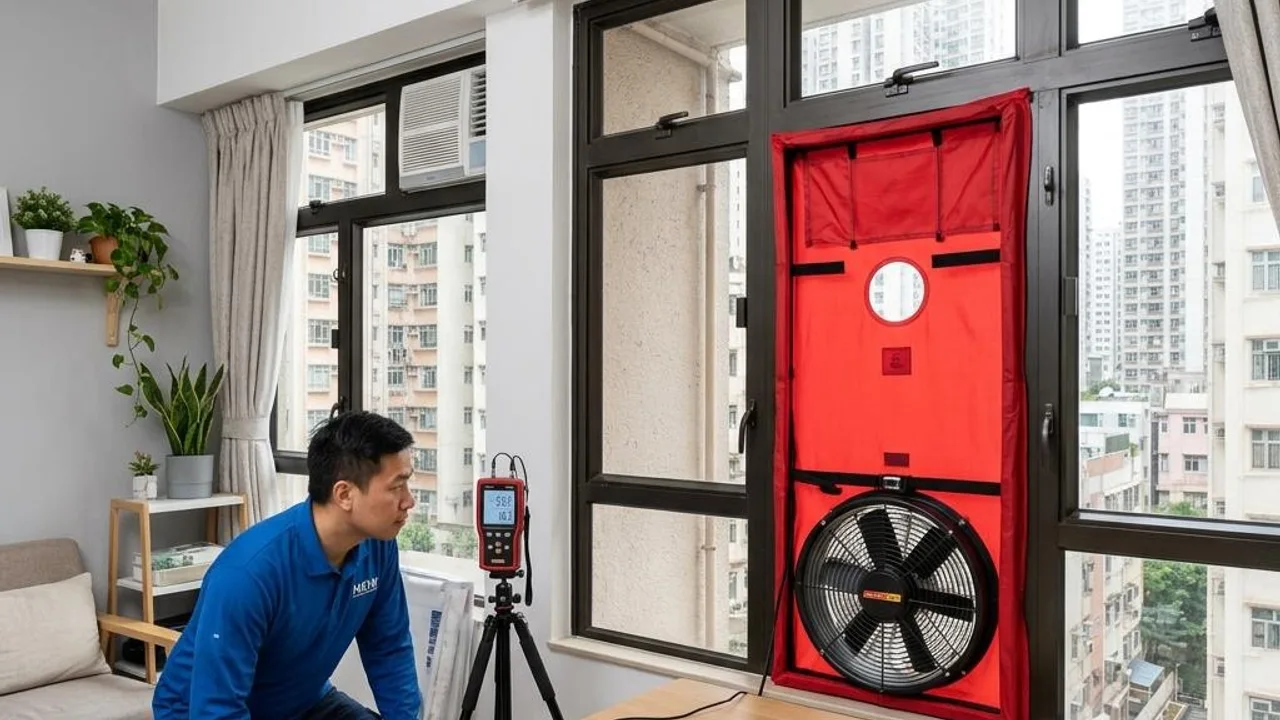
For issues that cannot be confirmed through simple observation, professional assessments typically consider pressure differential testing. This process requires specialized equipment to create a pressure gap between the interior and exterior, measuring the air permeability through instruments to accurately evaluate the airtightness performance of the entire window. This is currently a more objective technical indicator for evaluating overall window performance.
Although such testing involves specific equipment requirements, the data provided can accurately reflect whether the window has serious leakage problems. If it is found that the window airtightness performance is extremely poor, it is recommended that the owner consult a professional contractor to handle it, rather than performing temporary repairs themselves, so as to avoid affecting the structural safety of the window.
- Use professional instruments to measure pressure differential
- Evaluate the overall air permeability rate of the window
- Digitally assess the quality of airtightness performance
- Identify fine cracks that are difficult for the naked eye to detect
Post-inspection maintenance and precautions
When evaluating window airtightness, the influence of seasonal factors must be considered. It is recommended to perform the test during seasons with stable climate and mild wind to ensure consistency of measurement conditions. If the test is performed forcibly under severe weather conditions, environmental factors will interfere with the results, leading to errors in judgment. In addition, it is recommended to check multiple times at different times to obtain more comprehensive data.
If the test results confirm that the window has serious airtightness problems, the owner should consider taking repair measures. For simple sealing problems, replacing old sealing strips or re-applying structural adhesive often yields effective results. However, for cases involving window frame structural deformation or accessory damage, it is necessary to hire a qualified contractor for professional repairs to avoid the risk of structural instability caused by self-dismantling of the window.
- Avoid performing tests in extreme weather
- Multiple verifications should be carried out in a stable environment
- Choose repair solutions based on actual problems
- Professional support must be sought for structural problems
FAQs
Can property owners judge for themselves whether window air leakage is serious?
Property owners can perform a preliminary assessment through visual inspection of whether the sealing strip is hardened, as well as using the back of the hand to sense or smoke to observe whether there is obvious air leakage. However, issues involving structural deformation, etc., need to be confirmed by professionals.
Should repair or replacement be prioritized when a window air leak is found?
If the problem is limited to ageing sealing strips or peeling caulking, repair and replacement measures can be taken. If it involves window frame structural deformation, it is recommended to consult a qualified contractor for professional inspection and assessment.
Why is it not recommended to test window airtightness in high-wind weather?
High-wind weather will cause excessive external pressure differentials, which will not only interfere with the accuracy of simple tests, but if the window structure itself is already defective, high winds may increase risks during the testing process. Therefore, testing should be performed when the weather is calm.


