
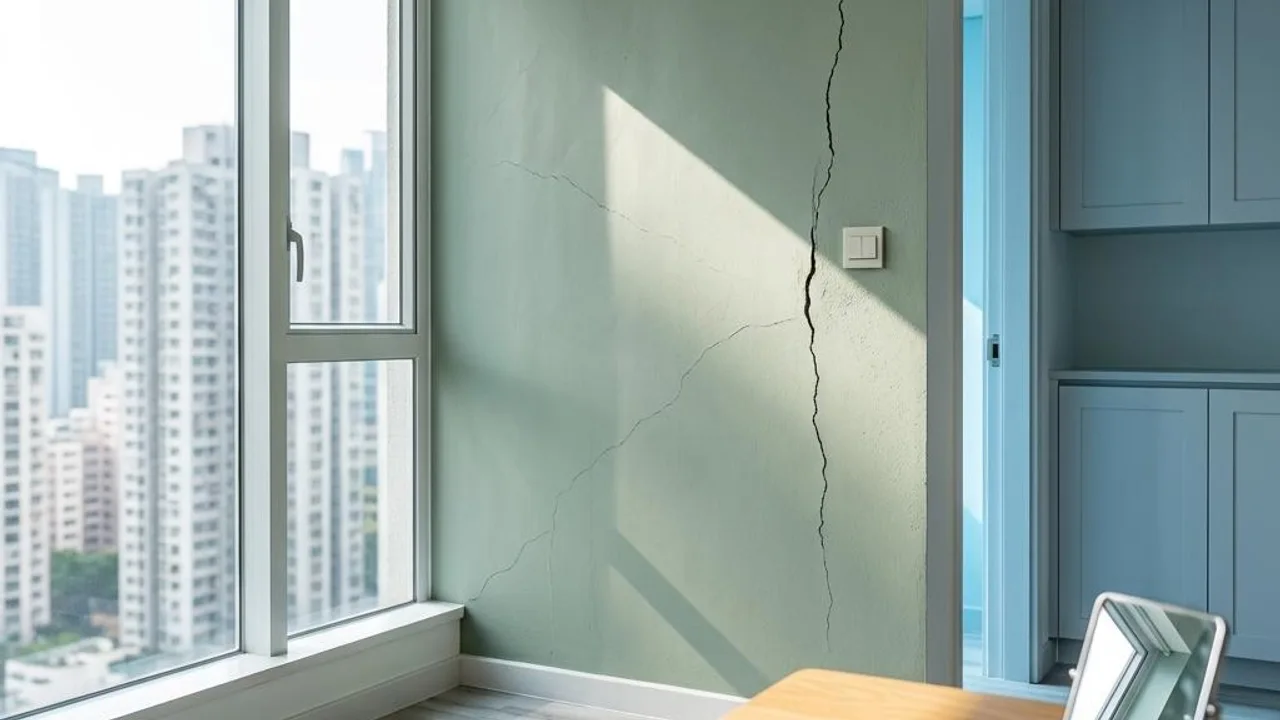
The visual illusion of light and the principle of observation
When conducting a property inspection in broad daylight, owners often feel reassured because the environment is bright, but they overlook the deceptive nature of light on vision. When faced with an environment with strong diffuse reflection, the human eye undergoes automatic adjustment and compensation, easily filtering out minor bumps, pinholes in plaster, or wall defects. If one relies solely on a direct front-on view during inspection, many concealed construction problems will be 'overlooked' due to the lack of sufficient light and shadow contrast.
To accurately discover problems, one must understand the difference between 'front lighting' and 'side lighting'. Front lighting makes walls appear uniform and smooth, while side lighting can project shadows, making surface defects appear three-dimensional and clear. Mastering the application of optics and viewing angles is the core key to avoiding 'missing things' during daytime inspections, and it is also the main difference between an owner's observation and a professional assessment.
- Front-on viewing causes the line of sight to be interfered with by ambient diffuse reflection
- Using side lighting and shadows can magnify tiny indentations
- Visual blind spots usually exist where light is too strong or the angle of illumination is improper
Using strong side lighting to inspect wall flatness
The most effective method for checking the quality of walls, plastering, or paint is to make good use of side light sources. Owners should not just stand in front of the wall, but should bring their bodies as close to the wall as possible and adjust their line of sight to an extremely inclined angle nearly parallel to the wall surface. If there is natural light streaming in diagonally from windows, one should make even better use of this light source to scan the wall.
Under this observation method, any tiny protrusions, wave patterns, or indentations on the wall will cast obvious shadows on the surface, which are known in building inspection as 'defect rectification marks'. By adjusting the observation angle, owners can effectively check whether the plastering layer is flat, and whether there is excessive variation in thickness during the paint sanding process.
- Keep your body close to the wall and adjust your line of sight to a parallel angle
- Observe the changes in shadows produced on the wall surface under lighting
- Focus on checking whether there are obvious indentations or wave patterns in the plastering
Reflection testing for glass and mirror defects
Window glass, mirrors, and high-gloss floor tiles are easily interfered with by strong external reflected light during the day. To detect whether there are scratches, pinholes, or deformation caused by stress on the surface, owners can judge by observing the reflections in the glass. Slowly move your head angle and note whether the reflections of objects outside the window become distorted or deformed in specific areas.
If there are slight defects on the glass surface, the reflection will appear unnaturally distorted like a hall-of-mirrors. This type of physical blind spot is usually difficult to discover through front-on observation alone. If persistent distortion in reflections is found, one should carefully check whether the area has signs of wear or if the glass was subjected to improper pressure during installation; if necessary, record the situation and request a follow-up.
- Slowly change your viewing angle to observe the reflections of objects outside the window
- Be alert to local distortion and deformation in reflections
- Check whether the glass surface has obvious pinholes or installation defects
Auxiliary verification techniques for daytime environments
Daytime property inspection does not mean the entire house must remain fully illuminated. When checking dark corners in the master bedroom, the inside of cabinets, or corridor ceilings, try drawing some curtains to moderately reduce ambient scattered light interference. At this point, using a high-intensity flashlight to shine on the target area at an angle of approximately 45 degrees can raise the detail quality to a higher level.
After creating a locally dimmed environment, many defects that are difficult to see during the day—such as uneven seals, cracked waterproof sealant, or paint touch-up marks—will be revealed. This method of alternating observation helps owners more comprehensively assess the construction completion of the unit and reduces the risk of missed inspections due to light interference.
- Moderately adjust curtains to create a locally dimmed environment
- Use a high-intensity flashlight to assist illumination at a 45-degree angle
- Check the flatness of joints and construction details in concealed corners
Using a low-angle view to check for floor height differences
Floor tiles and wooden floors occupy the largest area of a unit and are the areas where height difference defects are most likely to occur. When checking, owners should not just stand and look down; it is recommended to squat down, make your line of sight as parallel to the floor as possible, and look forward along the direction of the incoming light. This angle can intuitively reveal 'scissors gaps' between tiles or arching phenomena in wooden flooring.
Through a low-angle view, the drop between adjacent tiles becomes very obvious. Especially when light sweeps parallel across the floor, if the tiles are laid unevenly, the light and shadow will appear broken or the transition will look unnatural. This is crucial for ensuring stable furniture placement after moving in and for avoiding premature wear and tear on the floor.
- Squat down and take a low-angle view parallel to the floor
- Check for floor tile height differences along the direction of the light
- Inspect whether there is any arching at the joint positions of the wooden floor
FAQs
Why does observing the wall with the naked eye alone often lead to missing subtle construction defects?
The human eye automatically compensates for slight unevenness in a bright environment; without the shadow contrast produced by side lighting, it is difficult for the naked eye to distinguish wall flatness or plastering details.
When distorted glass reflections are found during move-in inspection, does it mean the glass quality is poor?
Distorted reflections usually suggest that the glass surface is uneven, scratched, or that stress deformation has occurred due to uneven force during installation. If this phenomenon is observed, it should be recorded in detail for follow-up inspection.
When should owners consider engaging professional personnel when conducting a daytime property inspection?
When it involves concealed structural inspections, suspected signs of water seepage, hollow tile detection, or high-level structural safety, it should be handled by an inspector with professional equipment to obtain an objective report to safeguard your own rights.


