
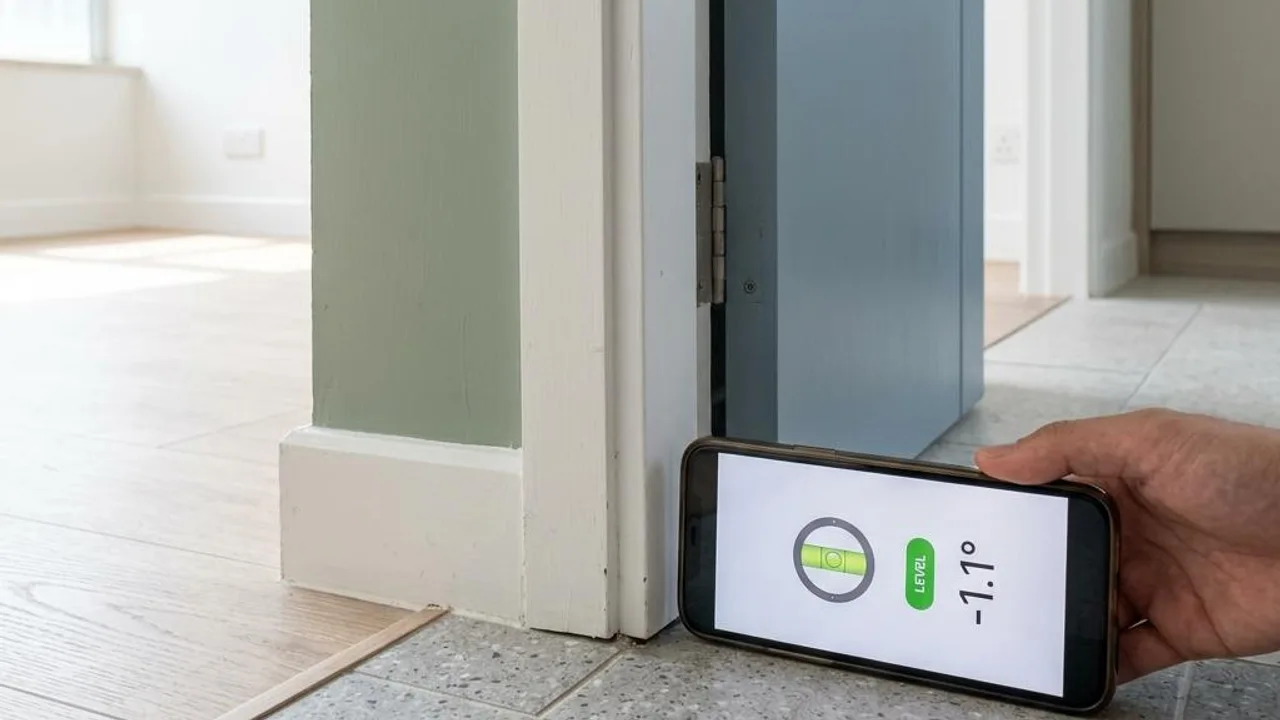
Physical limitations of built-in mobile tools.
Built-in mobile sensors are not designed for professional construction inspection, and lens modules and protective cases affect the level of contact, leading to measurement reading errors. Owners should not completely rely on such applications as the sole benchmark for testing building levels.
Even with a protective case, the uneven thickness of the case directly interferes with the readings. These external physical factors lead to reading deviations, resulting in distorted measurement results. Furthermore, the data provided by mobile applications often jumps in real-time, lacking the stable physical benchmark provided by a professional spirit level. For building acceptance requiring high precision, relying on mobile apps easily creates a false sense of security, leading owners to fail to discover actual tilting problems within the handover deadline.
- Protruding lenses cause the phone to be unable to sit flush against the measuring surface.
- The curvature of the phone body causes deviations in spirit level readings.
- Uneven thickness of protective cases impacts measurement accuracy.
- Lacks a physical measurement benchmark provided by professional long rulers.
Wall hollowness and structural hazards.
Aside from level measurements, hollow plastering on walls is a common issue during property inspection. Mobile apps are completely incapable of detecting the condition inside walls; if the plastering layer has separated from the substrate (hollow plastering), it is highly likely that large sections will peel off during future furniture installation, wall mounting of televisions, or drilling, which could even injure residents. Simple visual observation or mobile app detection cannot identify these hidden risks of delamination.
When addressing such situations, professional OPO Inspection inspectors use dedicated hollow-plastering hammers to tap surfaces, accurately pinpointing hollow spots through the crispness of the sound. This detection method requires extensive experience and specific acoustic benchmarks, which no mobile app can replicate. Untested hollow-plastering hazards will bring long-term home safety risks and maintenance burdens to the owner.
- Mobile apps cannot detect hollow plastering inside walls.
- Hollow plastering hazards lead to plaster peeling during future furniture installation.
- Professional hollow-plastering hammers can accurately pinpoint delamination locations.
- Correct handling can avoid future maintenance and safety issues.
The gap between professional equipment and field operation.
There are significant differences in tool precision and coverage between professional property inspection and independent owner inspection. Professional teams use high-precision laser levels that can handle millimetre-level tilt deviations, combined with infrared thermal imaging cameras to detect hidden water seepage and condensation issues. These devices not only provide structural physical data but also cover airtightness tests for water and electrical pipes that mobile apps cannot reach.
In contrast, the small tools owners carry themselves can only handle a very small portion of surface observations. Owners should understand during property inspection that professional equipment is the foundation for issuing objective inspection reports, aimed at assisting owners in presenting clear defect rectification requirements to the developer. Relying solely on your own small tools makes it difficult to form a persuasive defect rectification list, potentially causing you to miss the critical period for the developer to bear maintenance responsibilities.
- Laser levels provide millimetre-level precision inspection.
- Infrared thermal imaging cameras identify hidden sources of water seepage.
- Professional equipment has the capability to screen water and electrical airtightness.
- Professional reports provide a reference basis for handling defect rectification.
Practical tips for autonomous owner inspection.
In the absence of a professional, owners can perform preliminary screening through some intuitive physical methods. For example, testing the floor with a table tennis ball or marble and observing its rolling condition can simply reflect whether the floor has a noticeable tilt. Although this is not absolutely precise, if the ball rolls rapidly in a fixed direction, it is enough to warrant attention.
Similarly, when checking walls, you can use a metal coin or key to tap lightly, listening for a dull or hollow sound, which is an introductory method to help find larger areas of hollow plastering. Furthermore, you must carefully check the smoothness of door and window operations and the integrity of the window waterproof sealant strips. If you find operation is not smooth or light is visible around the window frame, these are specific details that must be listed on the property inspection checklist.
- Place a table tennis ball on the floor to observe its rolling trend.
- Use a metal coin to tap and test the hollow sound of walls.
- Check door lock operation smoothness and door gap alignment.
- Confirm whether the window frame waterproof sealant is completely sealed.
Comprehensive protection from professional inspection.
The OPO Inspection property inspection process covers comprehensive checks on flooring, walls, windows, water, and electricity. This systematic inspection approach aims to ensure that defect rectification work meets construction quality standards and protects the owner's residential rights. Third-party professional inspection provides impartial inspection reports to help clarify various engineering issues.
Correct operation of property inspection tools requires extensive experience to ensure that the results reflect true quality. Owners should use preliminary observations as a reference and commission a team with professional equipment and techniques to investigate hidden problems or safety details deeply, ensuring all potential hazards found during the property inspection stage are properly handled.
- Covers comprehensive inspection of flooring, walls, windows, and water and electricity.
- Ensure defect rectification work meets construction quality standards.
- Provides impartial and objective third-party inspection data.
- Professional equipment checks for hidden seepage issues.
FAQs
Why are mobile app spirit level inspection results inaccurate?
The protrusion of the mobile phone camera and the uneven thickness of the protective case prevent the phone from sitting flat against the floor. Additionally, mobile phone sensors are not designed for building acceptance, lacking a stable physical benchmark, which easily leads to reading deviations.
How can an owner find out if there is hollow plastering on the wall?
Owners can use a metal coin or key to tap the wall lightly and listen for a dull or hollow sound. If you suspect hollow plastering, you should commission an OPO Inspection professional to use a hollow-plastering hammer for a precise check.
How should one handle window frame seepage or abnormal noises during window operation upon property inspection?
Owners should record the location of the problem and the specific phenomenon in detail, notify the relevant unit for follow-up, and are strictly prohibited from dismantling the window frame or performing any dangerous exterior wall work themselves.


