
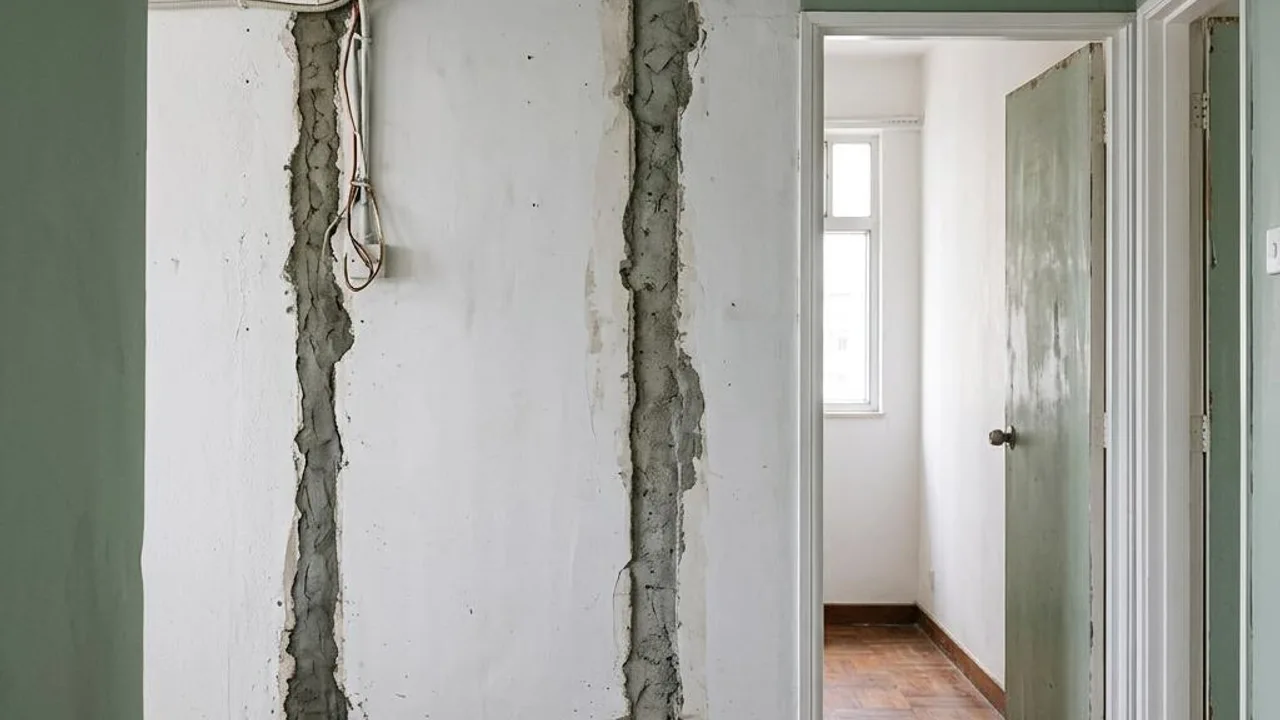
Clarifying Risks: 'Haunted Houses' vs. Structural Alterations
'Haunted houses' usually involve psychological and historical factors, referring to units where non-natural deaths have occurred. This can have a significant impact on mortgage approval and resale value, necessitating initial screening via land searches and bank valuations.
Structural alterations pose a direct threat to building safety. If a previous owner removed structural walls or columns without authorisation, it damages the overall structure of the building. This is a serious violation that carries both physical risks and potential legal liability.
- Historical and Psychological Impacts of 'Haunted Houses'
- The Dangers of Structural Alterations to Buildings
- The Warning Role of Bank Valuations
- The Importance of Property Land Searches
Identifying Partition Alterations: Marks on Floor Tiles and Walls
Observing floor tiles for patches is a common method for identifying wall removals. When old partition walls are removed, the ground usually leaves long, linear filling marks. If the surrounding materials have different colours, these are clear signs of alteration.
Walls are also a key focus for inspection. Re-plastered wall surfaces are often difficult to match perfectly in texture with the old walls. Owners can use side-lighting to check for surface flatness or tap gently with fingers to see if there is a hollow sound.
- Checking for Discrepancies in Floor Tile Materials and Colours
- Looking for Patches in Floor Grout
- Checking Wall Flatness and Colour Variations
- Using the Tapping Method to Confirm Wall Structure
Preventing Damage to Main Structural Elements
In many older buildings or Home Ownership Scheme (HOS) flats in Hong Kong, building plans clearly specify structural walls. Some illegal renovations use false walls to hide original structural columns. Buyers should compare the interior against official building plans to see if any walls are abnormally thick.
If a space is unexpectedly empty where a wall should be, one must be highly alert for illegal knock-through works. Unauthorized alterations involving structural walls may lead to statutory removal orders issued by the Buildings Department.
- Comparing with Official Building Plans
- Screening for Abnormally Thickened Walls
- Identifying Missing Partition Walls that Should Exist
- Observing if Carpentry is Deliberately Used to Cover Structures
Warning Signs of Door and Window Relocation
Private alterations to layouts usually involve moving doorways or blocking windows. Check for rough repair marks around door frames. If the doorway is significantly offset from the design of similar units on the same floor, there is a very high probability of unauthorized modification.
Observe if there are signs of windows having been sealed with cement, or if there are abnormal changes in materials around window frames. These traces often reveal non-compliant construction by previous owners to modify the layout.
- Checking for Door Frame Finishing Marks
- Comparing with Residential Estate Standard Floor Plans
- Checking for Signs of Sealed-up Windows on Walls
- Noting Anomalies on Walls Near Window Locations
Three-step Investigation for Haunted House Risks
Using online bank valuations is the most effective preventative measure. If a unit's valuation is abnormally low, or even if the bank refuses to provide a mortgage, it usually implies the unit has a 'haunted' or incident record, and the purchase plan should be halted immediately.
Make good use of public 'haunted house' websites and Land Registry searches. Use land searches to see if ownership changes are frequent, and request relevant declarations from estate agents. In addition, asking building management or neighbours on-site is also a good way to understand the unit's history.
- Performing Online Bank Valuation Tests
- Checking Land Registry Records
- Consulting Property Management Offices and Neighbours
- Requesting 'Haunted House' Search Declarations
The importance of a professional OPO Inspection team.
Visual observation is only an initial screening. When faced with complex structural assessments of load-bearing elements, water seepage hazards, and building regulation violations, a professional property inspection team possesses the expertise and testing equipment to provide more reliable analysis reports.
Hiring professionals for a property inspection is not just an investment in structural safety; it is also an insurance for the family's future living environment, reducing risks of later repairs and legal disputes.
- Professional Structural Safety Assessment
- Property inspection services cover only visually apparent conditions and cannot verify the safety or compliance of structural, electrical, or gas systems, the condition of hidden pipes, or the thickness of waterproof layers; nor can they assess the remaining service life or the effectiveness of repairs. Infrared thermal imaging displays surface temperature distribution only and cannot directly prove the cause of water leakage or hidden structural issues. Inspection tools provide clues and cannot guarantee the discovery of all concealed defects. The Mandatory Window Inspection Scheme is an independent procedure that must be performed by qualified persons registered with the Buildings Department and is outside the scope of this service. Specialist technical assessments and safety certification should be handled by appropriately qualified professionals. Homeowners should not dismantle electrical devices themselves, adjust water pressure valves, or climb onto roofs and exterior windows. Please retain objective observation records and subsequent follow-up advice, avoiding the use of unsubstantiated absolute promises.
- Professional Screening for Unauthorized Alterations
FAQs
Does an abnormally low bank valuation necessarily mean the unit is a 'haunted house'?
Not necessarily. While 'haunted house' records lead to low valuations or mortgage rejection, insufficient valuations can also be caused by market adjustments, the building's age, or mortgage risk assessments. It is recommended to perform a land search and consult a professional for verification.
What should an owner do if they discover a suspected structural wall has been removed?
Owners should not handle the matter themselves or attempt repairs; they should engage a qualified structural engineer to perform an assessment and compare the findings with the official building plans. If unauthorized alterations are confirmed, professional legal and architectural advice should be sought immediately to avoid bearing the responsibility for mandatory removal orders from the Buildings Department.
How can one distinguish between structural walls and general partition walls through observation?
Owners can first compare the locations indicated on the official building plans. Generally, structural walls are thick and cannot be altered at will, whereas partition walls are relatively thin. If there is doubt about the nature of the wall, hire a surveyor or professional inspector to use testing tools for analysis; do not rely on visual judgment alone.


